Canadian cookie and tracking requirements depend on what information a website collects, how it is used, and which visitors it serves. This guide explains how PIPEDA, provincial privacy laws, and different forms of consent affect websites serving Canadian visitors.
Does a website need a cookie banner in Canada?
Not automatically. Canada has no universal GDPR-style cookie banner rule, but meaningful consent may be required when cookies or similar technologies collect, use, or disclose personal information.
Express opt-in consent is generally appropriate for sensitive or unexpected tracking. A clear opt-out model may sometimes be acceptable for lower-risk online behavioural advertising. Websites serving Quebec residents must also consider Quebec’s private-sector privacy law.
The sections below help you determine what your website collects, which consent model may apply, and whether you need a cookie banner or another privacy control.
What Is PIPEDA?
PIPEDA is Canada’s federal private-sector privacy law. It applies to organizations that collect, use, or disclose personal information during commercial activities.
The law is technology-neutral. It does not create a special legal category only for cookies. Instead, the first question is whether the cookie, pixel, identifier, or other technology handles personal information about an identifiable individual.
Personal information may include obvious details such as a name or email address. It can also include technical and behavioural data when that information can identify a person directly or when it can be combined with other information to create an identifiable profile.
For website owners, relevant technologies may include:
- analytics cookies;
- advertising and remarketing pixels;
- device and browser identifiers;
- IP addresses combined with other information;
- local storage and similar browser storage;
- tracking links and web beacons;
- social media and video embeds;
- fingerprinting and cross-device tracking.
PIPEDA also requires organizations to limit their collection, use, and disclosure to purposes that a reasonable person would consider appropriate in the circumstances.
You can read the current text of PIPEDA on the Justice Laws website.
Does PIPEDA Require a Cookie Banner?
PIPEDA does not say that every website must show a pop-up called a cookie banner. What it requires is valid consent and appropriate handling of personal information when the law applies.
A banner or privacy choices interface is one practical way to:
- bring important tracking information to the visitor’s attention;
- explain the purposes of analytics, advertising, or profiling;
- offer an appropriate opt-in or opt-out choice;
- link to more detailed privacy and cookie information;
- allow the visitor to withdraw or change a choice.
A privacy policy alone may not be enough when important information is buried in a long document. The Office of the Privacy Commissioner of Canada, or OPC, says that key information should be brought forward when a person is making a privacy decision.
A small online store may use a necessary cookie to keep products in a shopping cart. That does not automatically create the same consent issue as a Meta Pixel that follows visitors for advertising and builds interest profiles.
What Does Meaningful Consent Mean?
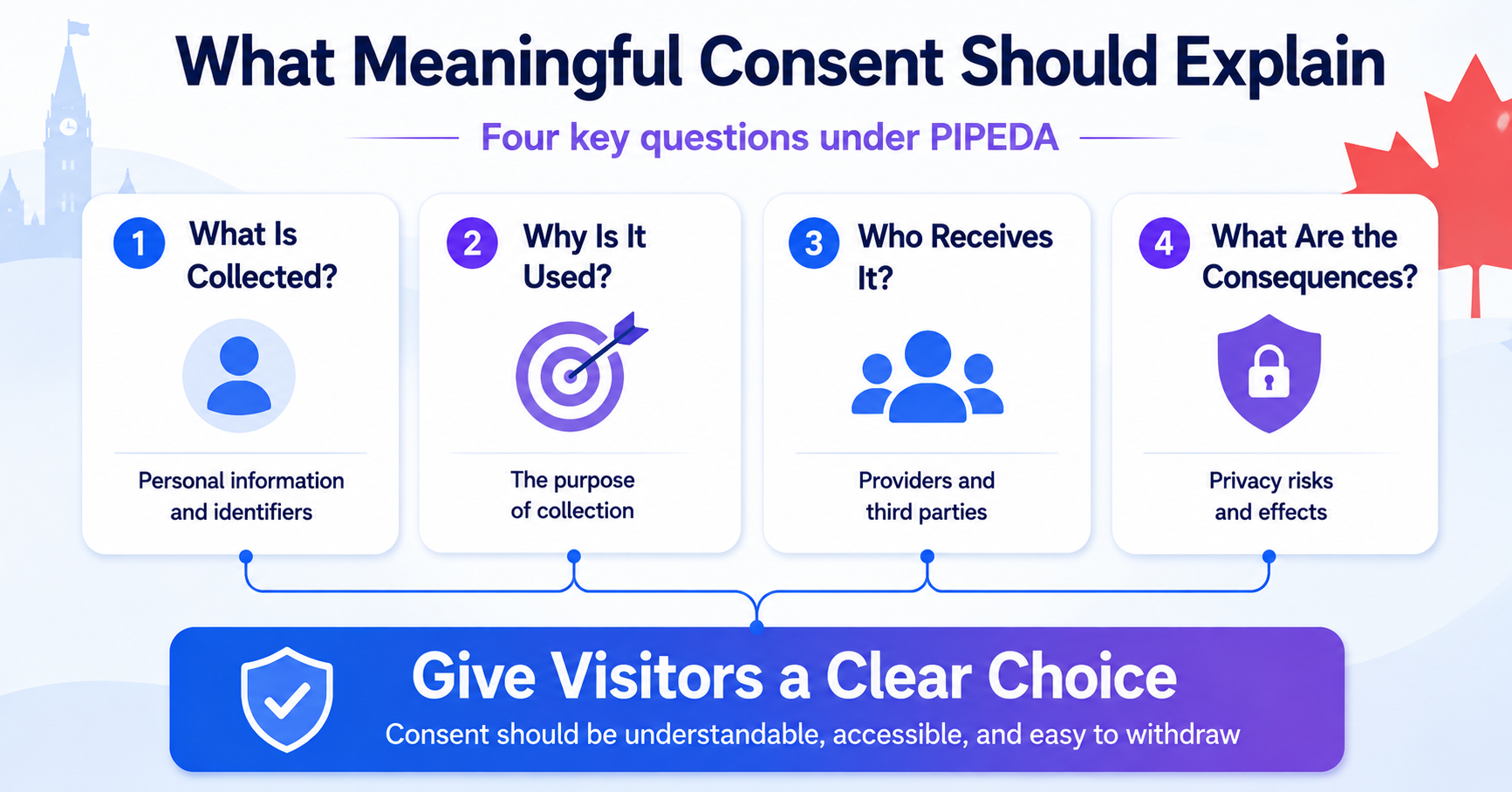
Meaningful consent means more than adding a sentence such as “By using this website, you agree to cookies.” A visitor should be able to understand the nature, purpose, and consequences of the collection, use, or disclosure of their personal information.
Canadian guidance on meaningful consent identifies four key elements that organizations should clearly explain:
- what personal information is being collected;
- which organizations or types of third parties receive it;
- why the information is collected, used, or disclosed;
- important risks, consequences, or possible harm.
The explanation should use plain language and be easy to access. Necessary purposes should be separated from optional purposes, and visitors should receive a clear choice for processing that is not necessary to provide the requested product or service.
Simply listing cookie names is not enough. A visitor needs to understand what the technologies do, which parties are involved, and how the resulting information may be used.
Express Consent vs Implied Consent
PIPEDA does not require the same form of consent in every situation. The appropriate choice depends on the sensitivity of the information, the visitor’s reasonable expectations, and the possible consequences.
| Consent type | How it works | When it may be appropriate |
|---|---|---|
| Express consent | The visitor actively agrees, for example by selecting a clearly explained option | Sensitive information, unexpected processing, or a meaningful residual risk of significant harm |
| Implied consent | Consent is inferred from the context and the visitor’s informed actions | Less sensitive information used for a purpose the visitor would reasonably expect |
| Opt-out consent | The practice is clearly explained and the visitor receives an easy way to decline | Some lower-risk online behavioural advertising when all OPC conditions are satisfied |
Organizations should generally obtain express consent when:
- the information is sensitive;
- the collection or use is outside the visitor’s reasonable expectations;
- the activity creates a meaningful residual risk of significant harm.
Sensitivity depends on context. Health, financial, biometric, political, religious, sexual orientation, and similar information will generally be sensitive, but other information can also become sensitive when combined or used in a particular way.
How Does PIPEDA Apply to Advertising Cookies?
Online behavioural advertising tracks activities over time to infer interests and select targeted advertisements. The OPC has explained that opt-out consent may sometimes be reasonable for this type of advertising, but only when important conditions are met.
The website should ensure that:
- the advertising purpose is clear and not hidden in a privacy policy;
- the visitor is informed at or before collection;
- the parties involved are explained;
- the visitor can easily opt out;
- the opt-out takes effect immediately and remains effective;
- the practice is limited to non-sensitive information;
- the information is destroyed as soon as possible or effectively de-identified.
If a visitor cannot meaningfully decline the tracking, or opting out makes the service unusable without a valid reason, the technology may not fit this opt-out model.
The OPC also advises organizations to avoid behavioural tracking of children and tracking on websites directed at children.
Do Analytics Cookies Require Consent in Canada?
There is no universal answer based only on the word “analytics.” Website owners should examine the tool and its real configuration.
Important questions include:
- Does the tool create or recognize a persistent identifier?
- Can the information identify a visitor alone or when combined with other data?
- Is the information shared with a third party?
- Does the provider use the information for its own purposes?
- Is the data used only for basic measurement or also for profiling and advertising?
- Would the visitor reasonably expect this use?
A basic, clearly explained, lower-risk measurement setup may be assessed differently from analytics connected to advertising, user profiles, or cross-site tracking. The label assigned by a plugin does not decide the legal result.
What About Necessary Cookies?
Cookies used only to provide a function requested by the visitor may present a lower consent risk than optional tracking. Possible examples include:
- shopping cart and checkout cookies;
- secure login and authentication cookies;
- fraud prevention and security controls;
- cookies that remember a privacy choice;
- technical session management.
Calling a cookie “necessary” is not enough. The website owner should be able to explain why the function cannot reasonably operate without it and ensure that the cookie is not also used for advertising or unrelated profiling.
Which Canadian Privacy Law Applies?
Canada has both federal and provincial private-sector privacy laws. PIPEDA is an important starting point, but it is not the only law a website may need to consider.
| Jurisdiction | Main private-sector framework | Website consideration |
|---|---|---|
| Federal | PIPEDA | Commercial handling of personal information, including interprovincial and international activities |
| Alberta | Provincial Personal Information Protection Act | Provincial private-sector rules may apply instead of or alongside PIPEDA depending on the activity |
| British Columbia | Provincial Personal Information Protection Act | Provincial private-sector requirements must be considered |
| Quebec | Act respecting the protection of personal information in the private sector, updated by Law 25 | Additional transparency, privacy governance, and technology-specific requirements may apply |
Alberta, British Columbia, and Quebec have private-sector laws that have been recognized as substantially similar to PIPEDA. PIPEDA can still apply to federally regulated organizations and to personal information moving across provincial or national borders.
Special Cookie and Tracking Rules in Quebec
Quebec’s Law 25 introduced important requirements for organizations using technologies with functions that identify, locate, or profile individuals.
When personal information is collected through such a technology, the organization must inform the person in advance:
- that the technology is being used;
- how the identification, location, or profiling functions can be activated.
The Commission d’accès à l’information du Québec explains that these functions cannot be activated by default. The person must be able to activate them voluntarily.
Organizations collecting personal information through technological means must also publish a clear privacy policy. The policy should explain what information is collected, why it is collected, which third parties may receive it, how it is protected, the use of cookies, and the individual’s rights.
Read the Quebec regulator’s guidance on collecting personal information through technology.
A configuration intended only for federal PIPEDA requirements may not cover every Quebec obligation. Websites serving Quebec residents should review Law 25 separately.
Do Foreign Websites Need to Follow PIPEDA?
A business does not necessarily need a physical office in Canada for PIPEDA to become relevant. Canadian decisions and OPC guidance use a “real and substantial connection” test.
Relevant factors can include:
- whether Canadians are a target audience;
- whether the service is offered to people in Canada;
- whether personal information about Canadians is collected;
- the source of the website’s content;
- the locations of the website operator and servers.
A foreign website should therefore not assume that Canadian privacy law is irrelevant simply because its business is registered elsewhere.
What Should a Canadian Cookie Banner Include?
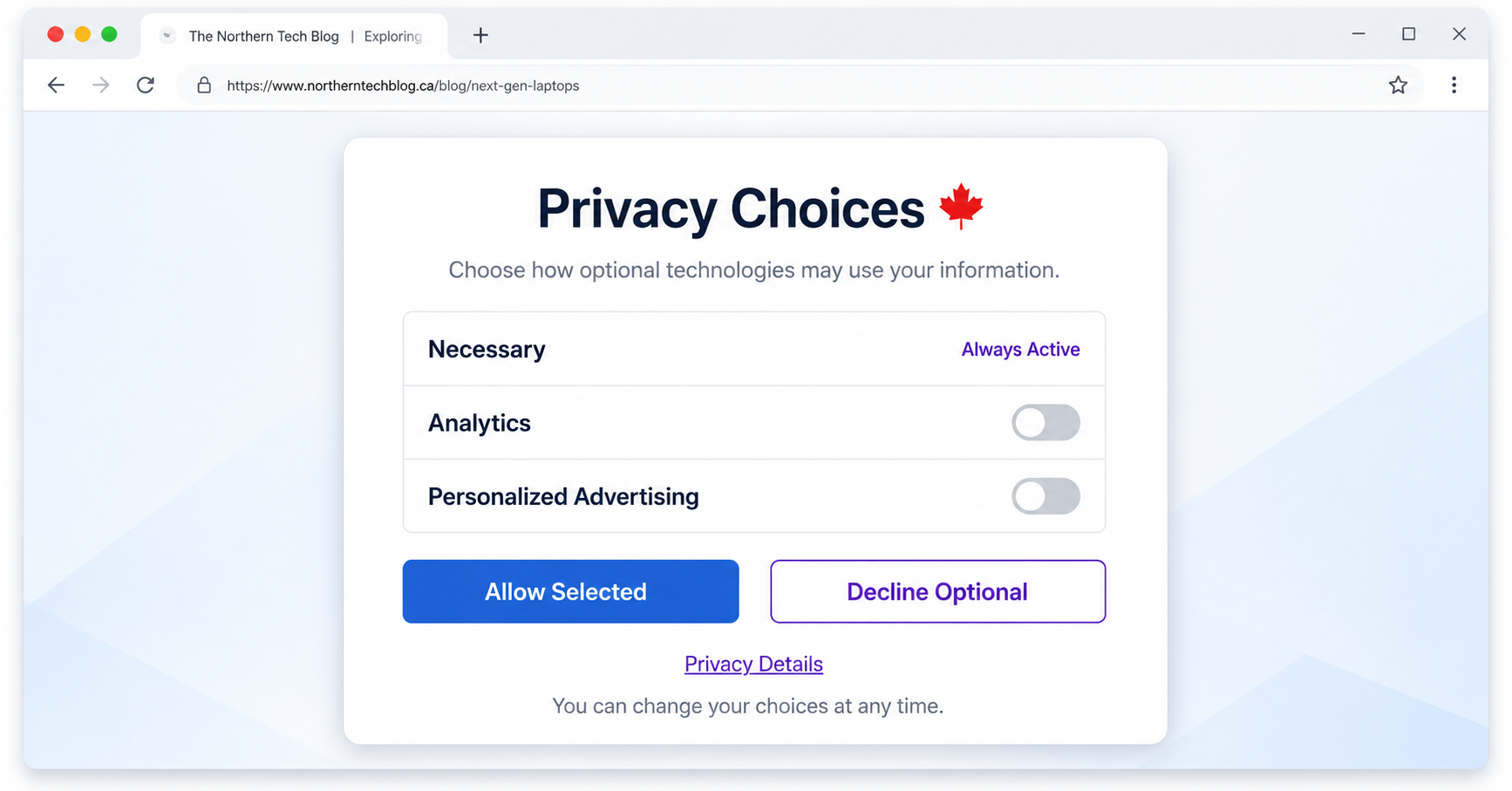
The correct design depends on the processing and applicable province. A practical Canadian consent interface may need to include:
- a plain-language explanation of the main purposes;
- the categories of personal information collected;
- the third parties or types of third parties involved;
- a distinction between necessary and optional purposes;
- an appropriate opt-in or opt-out control;
- an easy way to withdraw or change consent;
- a link to complete privacy and cookie information;
- regional behaviour when Quebec or other laws require different controls.
The buttons must change what the website actually does. If a visitor declines advertising, the website should stop the relevant tracking and not merely stop showing personalized advertisements.
Practical Canadian Website Examples
| Website setup | Likely starting point | What to check |
|---|---|---|
| Online store using only cart, checkout, and security cookies | A separate advertising-style opt-in may not be needed | Confirm that the cookies are limited to necessary store functions |
| Business website using basic analytics | Context-dependent consent and clear notice | Identifiers, sharing, purpose, retention, and reasonable expectations |
| Website using Meta Pixel and remarketing | Prominent privacy choice is likely needed | Profiling, third-party use, sensitivity, and whether opt-out conditions are satisfied |
| Health website using behavioural advertising | Express consent and additional caution | Whether sensitive health interests can be inferred or used |
| Service profiling Quebec visitors | Profiling functions should not be enabled by default | Prior notice, voluntary activation, and Law 25 requirements |
| Children’s website with advertising trackers | Avoid behavioural tracking | Whether meaningful consent can be obtained from the child or a guardian is required |
Canadian Cookie Consent Checklist
Use this checklist as a practical starting point for a website serving Canadian visitors.
- Scan the website for cookies, pixels, local storage, identifiers, and third-party requests.
- Determine which detected technologies handle personal information.
- Record the purpose of every technology and whether it is necessary.
- Identify every provider that receives or uses visitor information.
- Assess sensitivity, reasonable expectations, and possible harm.
- Choose express, implied, or opt-out consent only after evaluating the context.
- Bring key information forward instead of hiding it in a long privacy policy.
- Make declining and withdrawing consent clear and effective.
- Check whether Quebec, Alberta, or British Columbia rules also apply.
- Repeat the review after adding new analytics, advertising, embeds, or plugins.
Begin with our free cookie scanner if you do not yet know what your website loads.
Canada vs the European Union
Canada and the European Union both require transparency and meaningful control, but their common website consent models are not identical.
| Question | Canada | European Union |
|---|---|---|
| Is prior consent the universal starting point for non-essential cookies? | No single universal cookie rule; the correct consent form depends on context | Prior consent is commonly required unless a storage or access exception applies |
| Can opt-out consent be acceptable? | Sometimes, including qualifying lower-risk behavioural advertising | Generally not for non-essential cookies that require prior consent |
| What affects the form of consent? | Sensitivity, reasonable expectations, purpose, and risk | The storage purpose, applicable exception, and GDPR consent standard |
| Are regional differences important? | Yes, especially Quebec, Alberta, and British Columbia | Yes, national regulator interpretation can still matter |
For a wider comparison, see our guide to cookie consent laws around the world.
Conclusion
Canada does not require every website to display the same GDPR-style cookie banner. The correct approach depends on whether cookies and similar technologies process personal information, how sensitive that information is, what visitors reasonably expect, and which federal or provincial law applies.
Under PIPEDA, consent must be meaningful. Visitors should understand what information is collected, why it is used, who receives it, and the important consequences of their choice. Express consent is generally appropriate for sensitive, unexpected, or higher-risk processing. A carefully designed opt-out may sometimes work for lower-risk behavioural advertising, but only when the OPC’s conditions are satisfied.
Website owners should also check provincial rules, especially Quebec’s Law 25. The safest practical starting point is to scan the website, document each technology and purpose, and then select the consent model that fits the real processing.
This article provides general information about Canadian privacy and cookie consent requirements. It does not constitute legal advice.
Recommended Next Step
Now that you understand how PIPEDA and provincial privacy laws affect cookie consent, the next step is to apply these rules to your own website.
Check which cookies, analytics tools, advertising pixels, embeds, and other tracking technologies your website uses. This will help you determine whether you need a cookie banner, an opt-out mechanism, or another privacy control.

Frequently Asked Questions
Common questions about this topic
Canada does not have one universal rule requiring every website to display an EU-style cookie banner. However, a website may need a consent or privacy choices interface when cookies or similar technologies collect, use, or share personal information.
Meaningful consent means that visitors can understand what personal information is collected, why it is used, who receives it, and the important consequences of providing consent.
No. The appropriate form of consent depends on the sensitivity of the information, the visitor’s reasonable expectations, and the possible risks. Express consent is generally required for sensitive, unexpected, or higher-risk processing.
Sometimes. Opt-out consent may be acceptable when the practice is clearly explained, the information is not sensitive, visitors can easily decline, and the opt-out takes effect immediately and remains effective.
There is no universal answer for every Google Analytics setup. Website owners should consider the identifiers used, information sharing, configuration, purpose, visitor expectations, and applicable provincial privacy laws.
They may. Quebec’s Law 25 includes specific requirements for technologies that identify, locate, or profile individuals. These functions should not be activated by default, and visitors must be informed about how they can activate them.
It can. PIPEDA may apply when a foreign website or business has a real and substantial connection to Canada, even if it does not have a physical office there.
Yes. Organizations should provide a clear and accessible way for visitors to withdraw or change consent, subject to applicable legal or contractual restrictions. The website must also ensure that the relevant tracking responds to the updated choice.