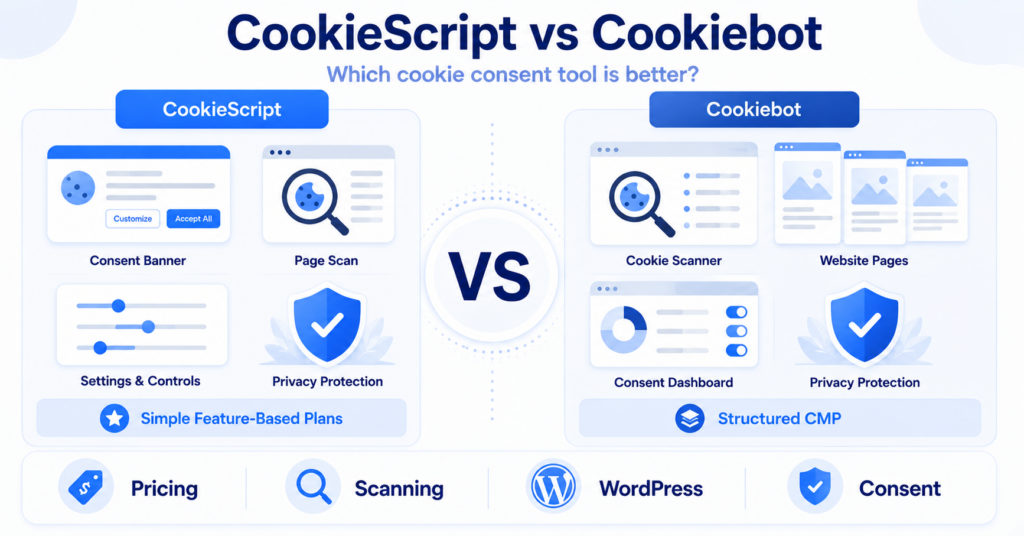
CookieScript and Cookiebot are both established cookie consent platforms, but their pricing models and plan structures work differently.
CookieScript combines feature-based plans with cookie scan limits, while its paid plans include unlimited monthly pageviews. Cookiebot Core bases its paid pricing mainly on the number of subpages detected on each domain.
In this comparison, we look at pricing, free plans, cookie scanning, automatic blocking, Google Consent Mode, WordPress setup, and which tool makes more sense for different types of websites.
CookieScript vs Cookiebot: Which Should You Choose?
Choose CookieScript if:
- you want a relatively simple consent-management setup
- you prefer feature-based plans with clear scan limits
- you want unlimited monthly pageviews on a paid plan
- you want an easy option for a small or medium website
- you want automatic monthly scans and script blocking on the appropriate paid tier
Choose Cookiebot if:
- you want a stronger free option for a website with more than 10 pages
- automated cookie scanning is especially important to you
- you want a more structured consent-management platform
- you prefer pricing based mainly on website subpages
- you need a platform-independent CMP for a more complex setup
There is no single winner for every website.
CookieScript is our preferred choice for simplicity and straightforward paid plans, while Cookiebot is stronger for automated scanning, platform flexibility, and more structured consent management.
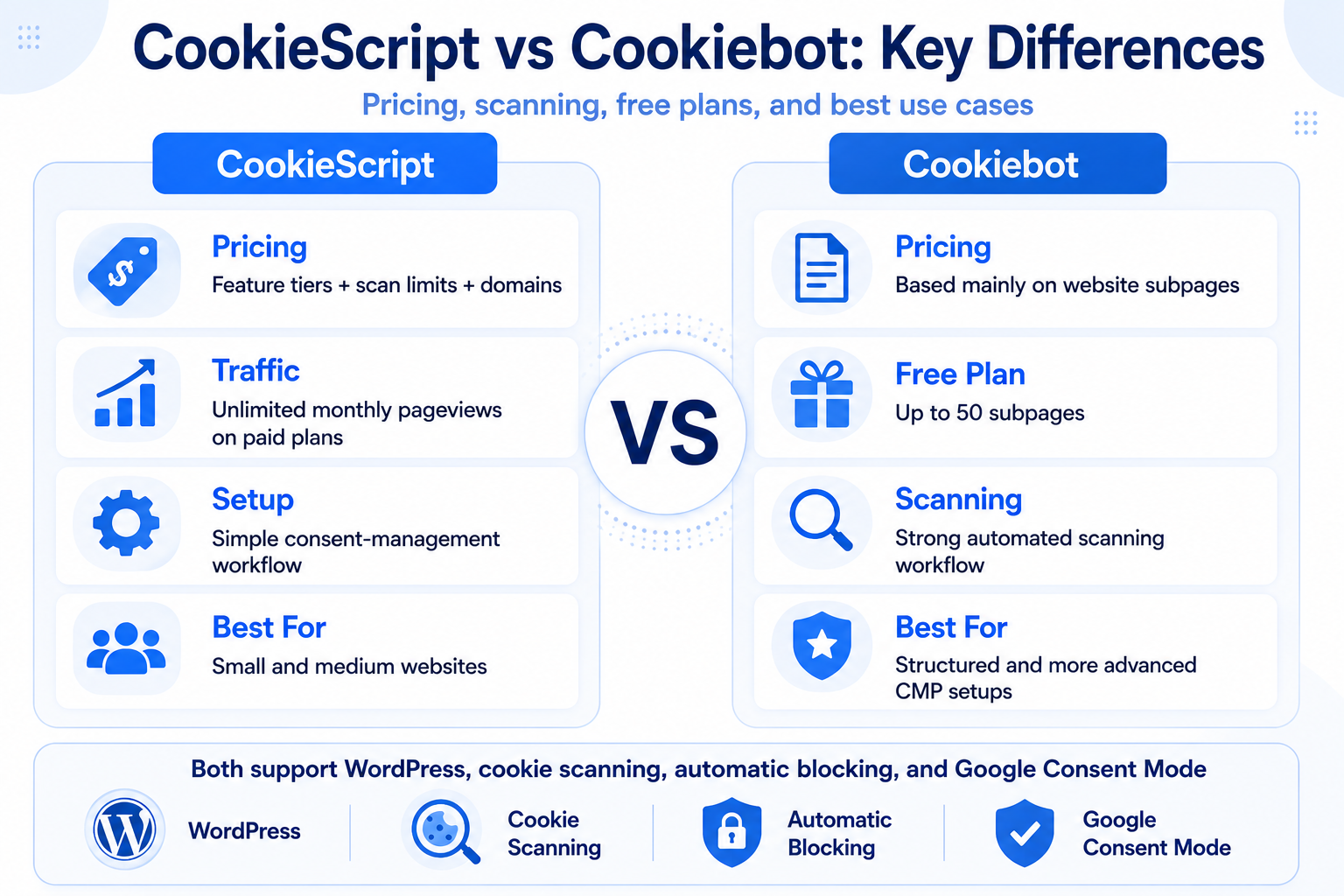
We compared current pricing, free-plan limits, cookie scanning, automatic blocking, banner controls, Google integrations, WordPress support, and overall consent-management workflows.
We also considered how each platform behaves as website size, scan requirements, and consent-management needs increase.
CookieScript vs Cookiebot at a Glance
| Feature | CookieScript | Cookiebot |
|---|---|---|
| Free plan | Yes | Yes |
| Main paid pricing model | Feature tier + scan limits + domains | Subpages per domain |
| Traffic on paid plans | Unlimited monthly pageviews | No traffic limit on Core paid plans |
| Free page limit | 10 pages scanned per domain | Up to 50 subpages |
| Cookie scanning | Yes | Yes |
| Automatic blocking | Available on higher paid tiers | Yes |
| Google Consent Mode | Yes | Yes |
| WordPress integration | Yes | Yes |
| Best fit | Simple small and medium website setups | Structured and scalable CMP setups |
Pricing checked: August 2026. CookieScript pricing varies by the number of domains selected. The CookieScript screenshot used for this comparison shows pricing for two domains.
The Biggest Difference: Feature Tiers vs Subpage-Based Pricing
The biggest difference between CookieScript and Cookiebot is how the paid plans are structured.
CookieScript combines feature tiers, scan limits, and the number of domains.
Cookiebot bases the Core plan mainly on the number of subpages on each domain.
Unlike CookieYes or CookieHub, traffic is not the main pricing pressure on either platform once you move to a paid plan.
CookieScript paid plans include unlimited monthly pageviews, while Cookiebot Core paid plans are also not priced according to traffic usage.
This means the real decision is more about page count, scanning needs, included features, and the type of consent workflow you want.
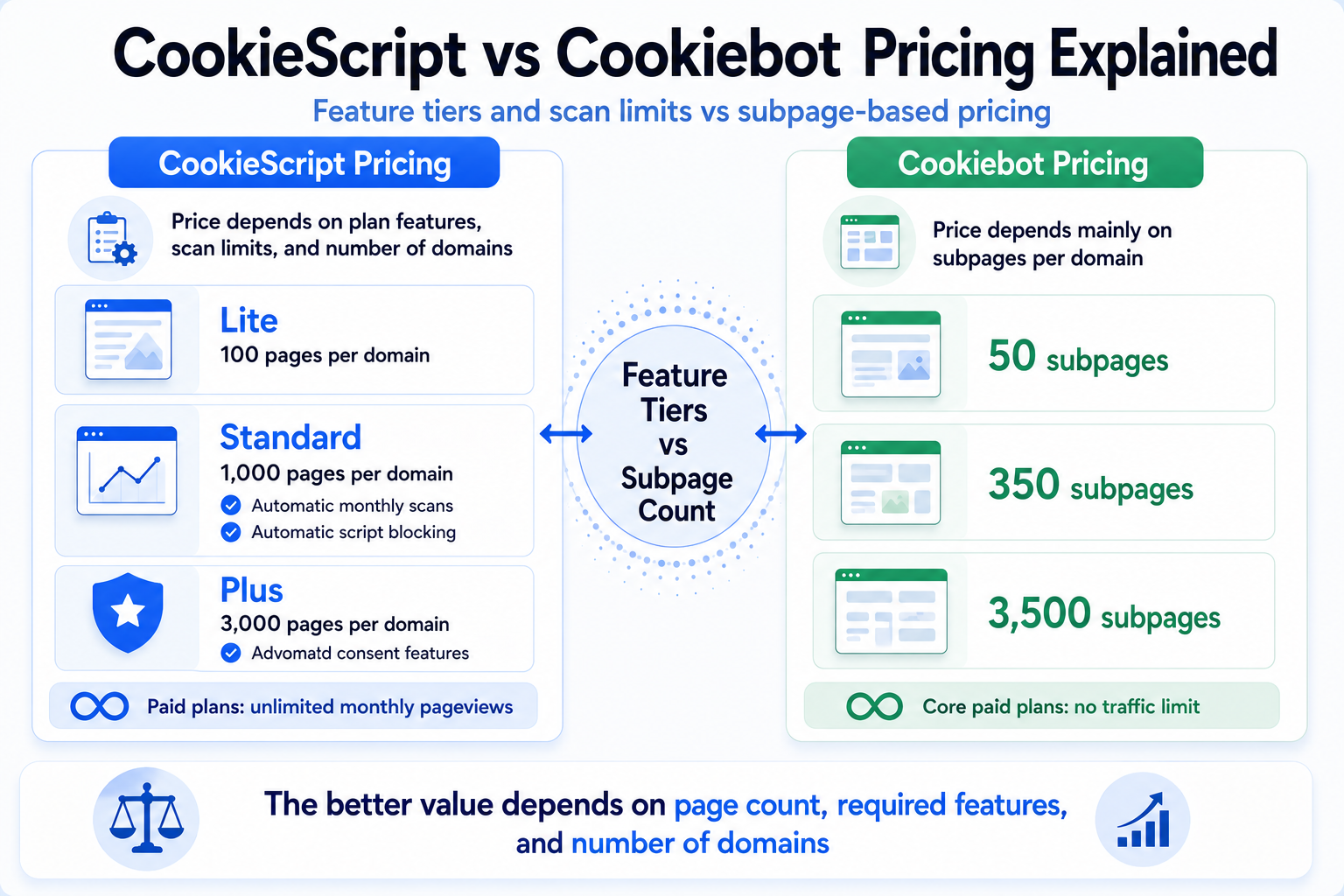
CookieScript Pricing
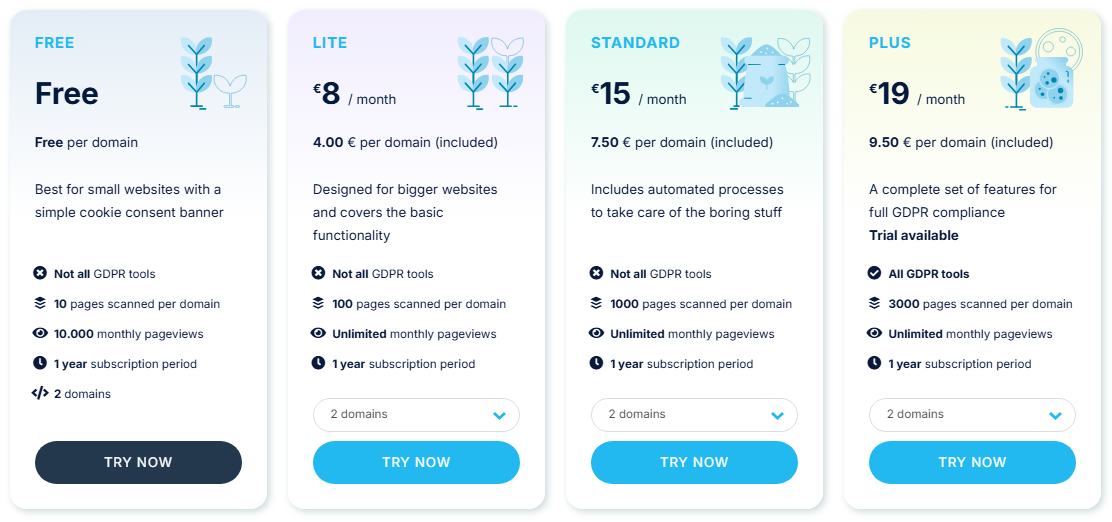
CookieScript pricing depends on the plan, the number of domains, and the number of pages that can be scanned per domain.
The pricing below reflects the two-domain configuration shown on the CookieScript pricing page checked in August 2026.
| Plan | Price Shown | Pages Scanned per Domain | Monthly Pageviews |
|---|---|---|---|
| Free | Free | 10 | 10,000 |
| Lite | €8/month | 100 | Unlimited |
| Standard | €15/month | 1,000 | Unlimited |
| Plus | €19/month | 3,000 | Unlimited |
CookieScript Free includes Google Consent Mode and support for 42 languages, but it is limited to 10 scanned pages per domain and 10,000 monthly pageviews.
Lite expands the scan limit to 100 pages per domain and removes the monthly pageview limit.
Standard increases the scan limit to 1,000 pages per domain and adds important automation features such as automatic monthly scans and automatic script blocking.
Plus increases the scan limit to 3,000 pages per domain and adds the most complete feature set, including features such as consent recording, IAB TCF integration, cross-domain consent, banner analytics, and API access.
Want a full breakdown of CookieScript Free, Lite, Standard, and Plus?
Cookiebot Pricing
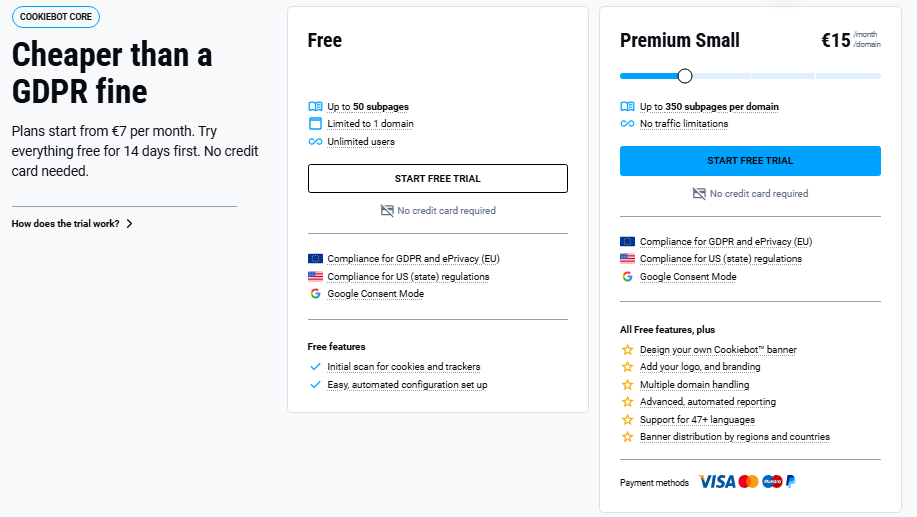
Cookiebot Core uses a different pricing structure.
Your plan is determined mainly by the number of subpages detected on each domain.
| Plan | Monthly Price | Subpage Limit |
|---|---|---|
| Free | €0 | Up to 50 |
| Premium Lite | €7/domain | Up to 50 |
| Premium Small | €15/domain | Up to 350 |
| Premium Medium | €30/domain | Up to 3,500 |
| Premium Large | €50/domain | Up to 7,000 |
| Premium XLarge | €90/domain | More than 7,000 |
Cookiebot does not charge Core customers according to pageviews or traffic usage.
This makes the number of website pages much more important than visitor volume when calculating the appropriate plan.
Want to see every Cookiebot plan in more detail?
Which Is Cheaper: CookieScript or Cookiebot?
There is no universal answer because CookieScript pricing also changes with the number of domains selected.
The examples below focus on the pricing structures rather than treating one platform as automatically cheaper.
Example 1: Small Website With Around 40 Pages
A 40-page website fits inside Cookiebot Premium Lite:
Cookiebot: €7/month/domain
CookieScript Free only scans 10 pages per domain, so a 40-page website would need at least a paid CookieScript tier if the complete site needs to be scanned.
CookieScript Lite supports up to 100 pages per domain and unlimited monthly pageviews.
For a single small website, the exact price comparison depends on the number of domains selected in CookieScript, but Cookiebot can be very competitive at this size.
Example 2: 200-Page Website
A 200-page site exceeds the CookieScript Lite scan limit of 100 pages per domain.
That means CookieScript Standard, with up to 1,000 scanned pages per domain, becomes the more appropriate tier.
On Cookiebot, a 200-page website fits into Premium Small:
Cookiebot: €15/month/domain
At this size, the two platforms can become much closer in price, and the decision depends more on included features and domain count.
Example 3: Small Website With Very High Traffic
High traffic alone is not a major pricing disadvantage on either paid platform.
CookieScript paid plans include unlimited monthly pageviews.
Cookiebot Core paid plans are also not priced by traffic.
For this type of website, the better choice depends more on:
- page count
- scan requirements
- automation features
- number of domains
- desired consent-management workflow
Simple website and feature-based plan preference: CookieScript can be easier to understand.
Low page count and structured subpage-based pricing: Cookiebot can offer excellent value.
CookieScript vs Cookiebot Free Plan
Both platforms offer a free option, but Cookiebot has a clear website-size advantage.
CookieScript Free
CookieScript Free includes:
- up to 10 pages scanned per domain
- 10,000 monthly pageviews
- Google Consent Mode
- 42 languages
The 10-page scan limit makes it most suitable for very small websites.
Cookiebot Free
Cookiebot Free supports:
- one domain
- up to 50 subpages
- unlimited users
- an initial cookie and tracker scan
- automated configuration setup
- Google Consent Mode
Which Free Plan Is Better?
Cookiebot wins the Free-plan comparison for most websites.
The biggest reason is the website-size allowance: up to 50 subpages compared with CookieScript Free’s 10 scanned pages per domain.
CookieScript Free remains useful for a very small website that stays within both its scan and monthly pageview limits.
Cookie Scanning and Automatic Blocking
Both platforms provide cookie scanning, but Cookiebot has the stronger overall scanning workflow.
CookieScript scan limits depend on the plan. Automatic monthly scanning and automatic script blocking are included from the Standard tier in the pricing configuration reviewed for this article.
Cookiebot makes automated scanning and cookie classification a more central part of its CMP workflow.
Cookiebot also supports automatic cookie blocking, which prevents non-essential cookies from being set until the appropriate consent is provided.
Winner for scanning and structured automation: Cookiebot.
Cookie Banner Customization
Both CookieScript and Cookiebot provide flexible consent-banner controls.
CookieScript paid plans can include features such as:
- custom colors
- geo-targeting
- self-hosted code
- privacy policy generation
- branding removal
- advanced banner features on higher tiers
Cookiebot Premium also provides strong banner customization, branding options, multiple languages, and regional banner distribution.
For users who want a straightforward visual setup, CookieScript has a slight usability advantage.
Cookiebot remains stronger when banner settings are part of a broader structured CMP configuration.
Google Consent Mode and Google Tag Manager
Both CookieScript and Cookiebot support Google Consent Mode.
CookieScript allows Google Consent Mode to be enabled in the banner settings and supports implementation through Google Tag Manager.
Cookiebot also supports Google Consent Mode, including WordPress and GTM deployment options.
Both can work with websites using:
- Google Analytics
- Google Ads
- Google Tag Manager
This category is a tie.
Want to understand what Google Consent Mode actually does?
CookieScript vs Cookiebot for WordPress
Both platforms can be used on WordPress.
CookieScript on WordPress
CookieScript offers a WordPress integration and also supports the WP Consent API.
The overall workflow is relatively straightforward: configure the banner, connect it to the website, and manage consent behavior through CookieScript.
For users who want a simpler consent setup without a large number of CMP configuration layers, CookieScript is approachable.
Cookiebot on WordPress
Cookiebot also provides a dedicated WordPress plugin.
Its WordPress setup connects the site to the broader Cookiebot CMP and supports scanning, automatic blocking, consent banners, and Google Consent Mode.
The configuration is more structured than CookieScript, but that additional structure can be useful for websites with more demanding consent-management requirements.
Want to see how each tool works in practice?
Which Is Better for Different Types of Websites?
| Website Type | Better Fit | Why |
|---|---|---|
| Very small website | Depends | CookieScript is simple, while Cookiebot Free allows more pages |
| Small business website | CookieScript | Simple feature-based plans and easy workflow |
| Website with up to 50 pages needing a free plan | Cookiebot | Larger Free-plan website allowance |
| Website where automated scanning is a priority | Cookiebot | Scanning is more central to the CMP workflow |
| High-traffic website | Depends | Both paid models can support unlimited traffic |
| Simple WordPress consent setup | CookieScript | Straightforward configuration |
| Structured multi-platform CMP setup | Cookiebot | Broader platform-independent consent-management workflow |
CookieScript Pros and Cons
Pros
- simple consent-management workflow
- unlimited monthly pageviews on paid plans
- clear feature-based plan progression
- Google Consent Mode support
- WordPress integration
- good banner customization
- automatic monthly scans and script blocking available on Standard and higher tiers
Cons
- Free plan only scans 10 pages per domain
- automatic scanning and blocking require a higher paid tier
- pricing changes with the number of domains
- Lite and Standard do not include the complete feature set available on Plus
Cookiebot Pros and Cons
Pros
- Free plan supports up to 50 subpages
- strong automated cookie scanning
- automatic cookie blocking
- structured consent-management workflow
- paid Core plans are not limited by traffic
- Google Consent Mode support
- strong platform flexibility
- well suited to more advanced CMP requirements
Cons
- price increases as website subpage count grows
- each domain is evaluated separately
- setup can feel more structured than simpler alternatives
- content-heavy websites can move into higher pricing tiers
CookieScript vs Cookiebot: Which Is Better?
CookieScript and Cookiebot are strong in different areas, so we would not give one platform a universal victory.
CookieScript is our preferred choice for website owners who prioritize simplicity, straightforward feature tiers, and an easy small-business consent workflow.
Cookiebot is our preferred choice for users who prioritize automated scanning, a stronger Free plan for larger small websites, platform flexibility, and more structured consent management.
The right choice therefore depends less on website traffic and more on your page count, required features, number of domains, and the type of CMP workflow you want.
| Category | Our Pick |
|---|---|
| Best for simplicity | CookieScript |
| Best for small business websites | CookieScript |
| Best free plan | Cookiebot |
| Best cookie scanning workflow | Cookiebot |
| Best structured consent management | Cookiebot |
| Best banner customization simplicity | CookieScript |
| Best platform flexibility | Cookiebot |
| Google Consent Mode | Tie |
| High-traffic pricing | Tie / Depends |
CookieScript vs Cookiebot Scorecard
| Category | CookieScript | Cookiebot |
|---|---|---|
| Ease of use | 4.5 / 5 | 4.0 / 5 |
| Free plan | 4.0 / 5 | 4.5 / 5 |
| Pricing flexibility | 4.5 / 5 | 4.5 / 5 |
| Cookie scanning | 4.5 / 5 | 5.0 / 5 |
| Automatic consent controls | 4.0 / 5 | 4.5 / 5 |
| Banner customization | 4.5 / 5 | 4.0 / 5 |
| WordPress simplicity | 4.5 / 5 | 4.0 / 5 |
| Google integration | 5.0 / 5 | 5.0 / 5 |
| Platform flexibility | 4.5 / 5 | 5.0 / 5 |
| Advanced consent management | 4.0 / 5 | 5.0 / 5 |
The scores are intended as a practical comparison for small and medium website owners rather than a universal ranking for every business.
Conclusion
CookieScript and Cookiebot are both capable consent management platforms, but they serve slightly different priorities.
CookieScript is the better fit for users who want simplicity, clear feature-based plans, unlimited monthly pageviews on paid tiers, and a straightforward small-business workflow.
Cookiebot is the better fit for users who prioritize automated scanning, a stronger Free plan for websites with more pages, platform flexibility, and a more structured consent-management environment.
Compare the Tool That Fits Your Priorities
If simplicity is your priority, take a closer look at CookieScript. If automated scanning and structured consent management matter more, Cookiebot may be the stronger fit.

Frequently Asked Questions
Common questions about this topic
CookieScript can be better for website owners who prioritize a simple setup, straightforward feature tiers, and easy banner customization. Cookiebot is stronger in automated scanning, structured consent management, and platform flexibility.
Cookiebot can be better when automated scanning, a stronger Free-plan page allowance, and a more structured CMP workflow are important. CookieScript can be easier for a typical small or medium website.
It depends on website size, domain count, and required features. Cookiebot pricing depends mainly on subpage count, while CookieScript pricing combines domain count, scan limits, and feature tiers
Yes. CookieScript Free includes up to 10 scanned pages per domain, 10,000 monthly pageviews, Google Consent Mode, and support for 42 languages.
Yes. Cookiebot Free supports one domain with up to 50 subpages.
subpages, while CookieScript Free is limited to 10 scanned pages per domain.
Yes. Both platforms support Google Consent Mode and provide implementation options for websites using Google Analytics, Google Ads, and Google Tag Manager.
CookieScript is easier if you want a relatively simple WordPress consent setup. Cookiebot provides a more structured CMP integration and may be more suitable when advanced scanning and consent-management controls are important.