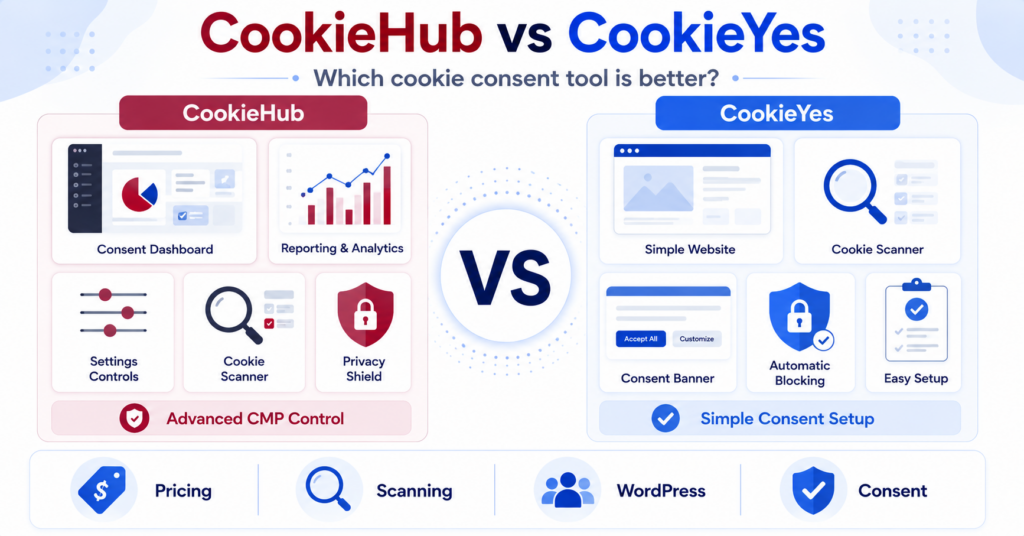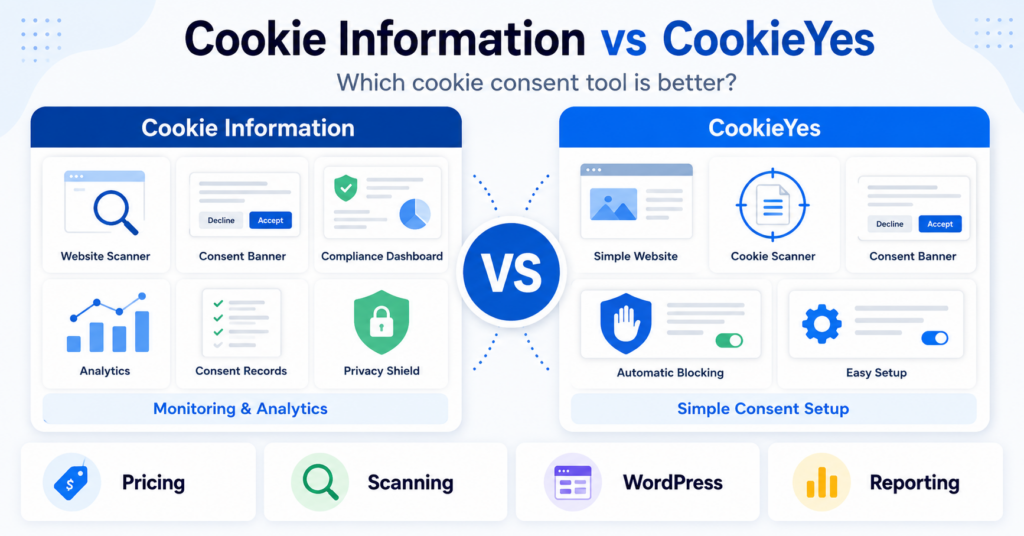
Cookie Information and CookieYes both help websites manage cookie consent, scanning, blocking, and Google Consent Mode, but they are built around different priorities.
Cookie Information puts more emphasis on compliance monitoring, consent analytics, reporting, and EU-focused consent management. CookieYes focuses more on a simpler self-service experience with a strong free plan, clear paid tiers, and an easy setup for small websites and WordPress users.
In this comparison, we look at pricing, scanning, automatic blocking, reporting, WordPress support, and which platform is better for different types of websites.
Cookie Information vs CookieYes: Which Should You Choose?
Choose Cookie Information if:
- you want stronger compliance monitoring and reporting
- consent-rate analytics matter to your business
- you value EU-based infrastructure and hosting
- you want audit-ready consent records
- you want more visibility into compliance risks and tracking changes
- ongoing compliance management matters more than having the cheapest entry plan
Choose CookieYes if:
- you want a simple and beginner-friendly setup
- you run a small business, blog, or WordPress website
- you want a strong permanent Free plan
- you prefer clear pricing tiers and a lower paid entry point
- you want generous page-scan limits
- you mainly need straightforward cookie consent management
CookieYes is our preferred choice for most small and medium websites that want a straightforward cookie consent solution.
Cookie Information is the stronger choice for businesses that want deeper compliance monitoring, reporting, consent analytics, and ongoing visibility into their consent setup.
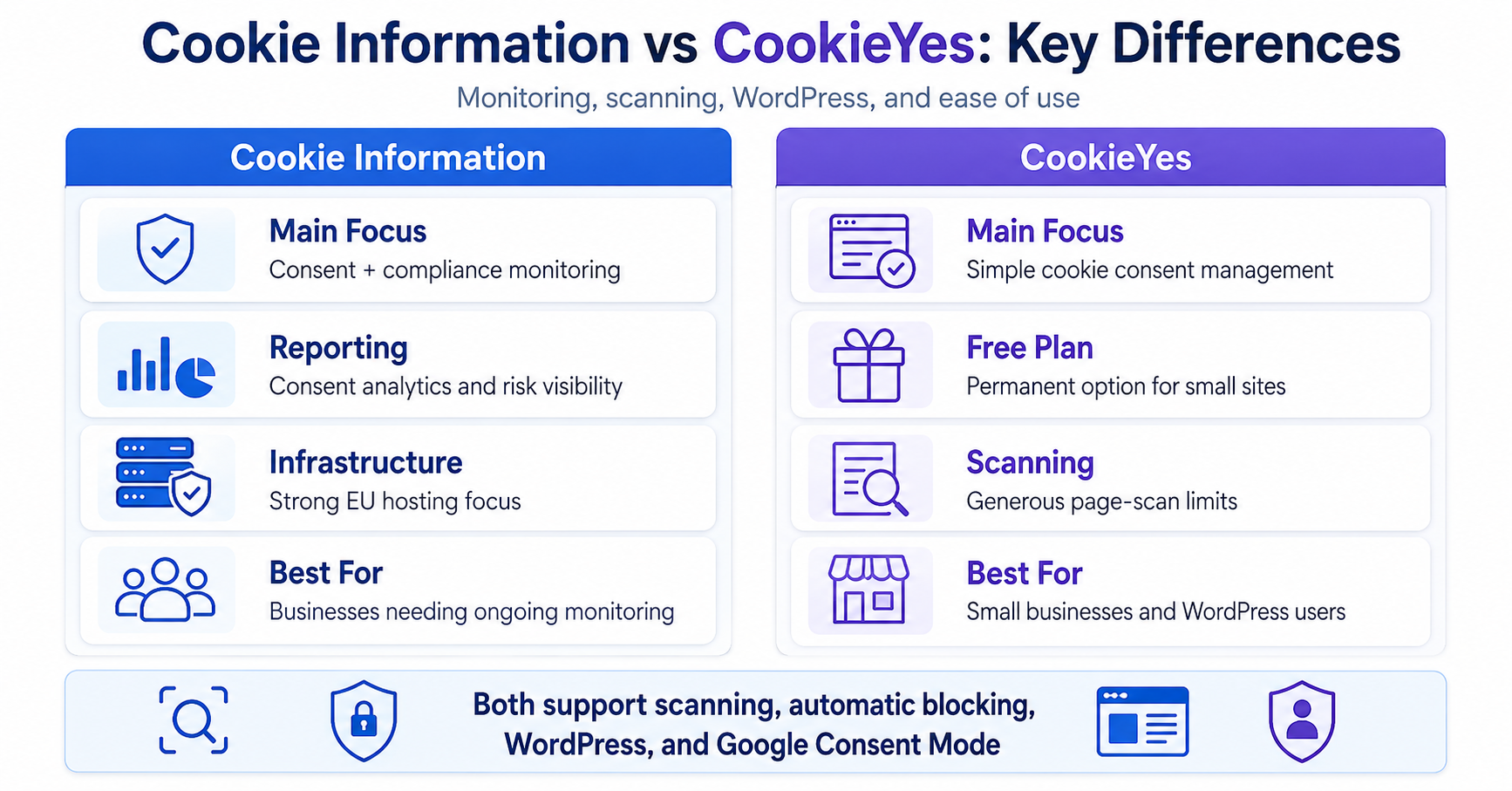
We compared current pricing, free-plan availability, cookie scanning, automatic blocking, consent records, reporting, compliance monitoring, Google integrations, WordPress support, and overall ease of use.
We also considered the main strategic difference between the platforms: deeper compliance monitoring versus simpler self-service consent management.
Cookie Information vs CookieYes at a Glance
| Feature | Cookie Information | CookieYes |
|---|---|---|
| Permanent Free plan | No | Yes |
| Free trial | Yes | Yes on paid plans |
| Main focus | Consent + compliance monitoring | Simple self-service consent management |
| Main pricing factor | Scanned URLs, scan frequency, and usage | Plan tier, pageviews, and scan limits |
| Cookie scanning | Yes | Yes |
| Automatic blocking | Yes | Yes |
| Consent records | Strong audit-focused records | Yes |
| Consent analytics | Strong | Available, but less central |
| Compliance monitoring | Strong focus | More limited focus |
| Google Consent Mode | Yes | Yes |
| WordPress | Yes | Yes |
| Best fit | Businesses needing monitoring and reporting | Small and medium websites wanting simple consent |
Pricing checked: August 2026. Cookie Information uses a more configurable pricing model, while CookieYes offers clearer self-service tiers with defined pageview and scan allowances.
The Biggest Difference: Compliance Monitoring vs Simpler Self-Service CMP
Both Cookie Information and CookieYes can handle the core tasks expected from a modern consent management platform.
They can scan a website, identify cookies and trackers, display a consent banner, block non-essential technologies, and connect consent choices with services such as Google Analytics and Google Ads.
The bigger difference appears in how the platforms are designed to be managed over time.
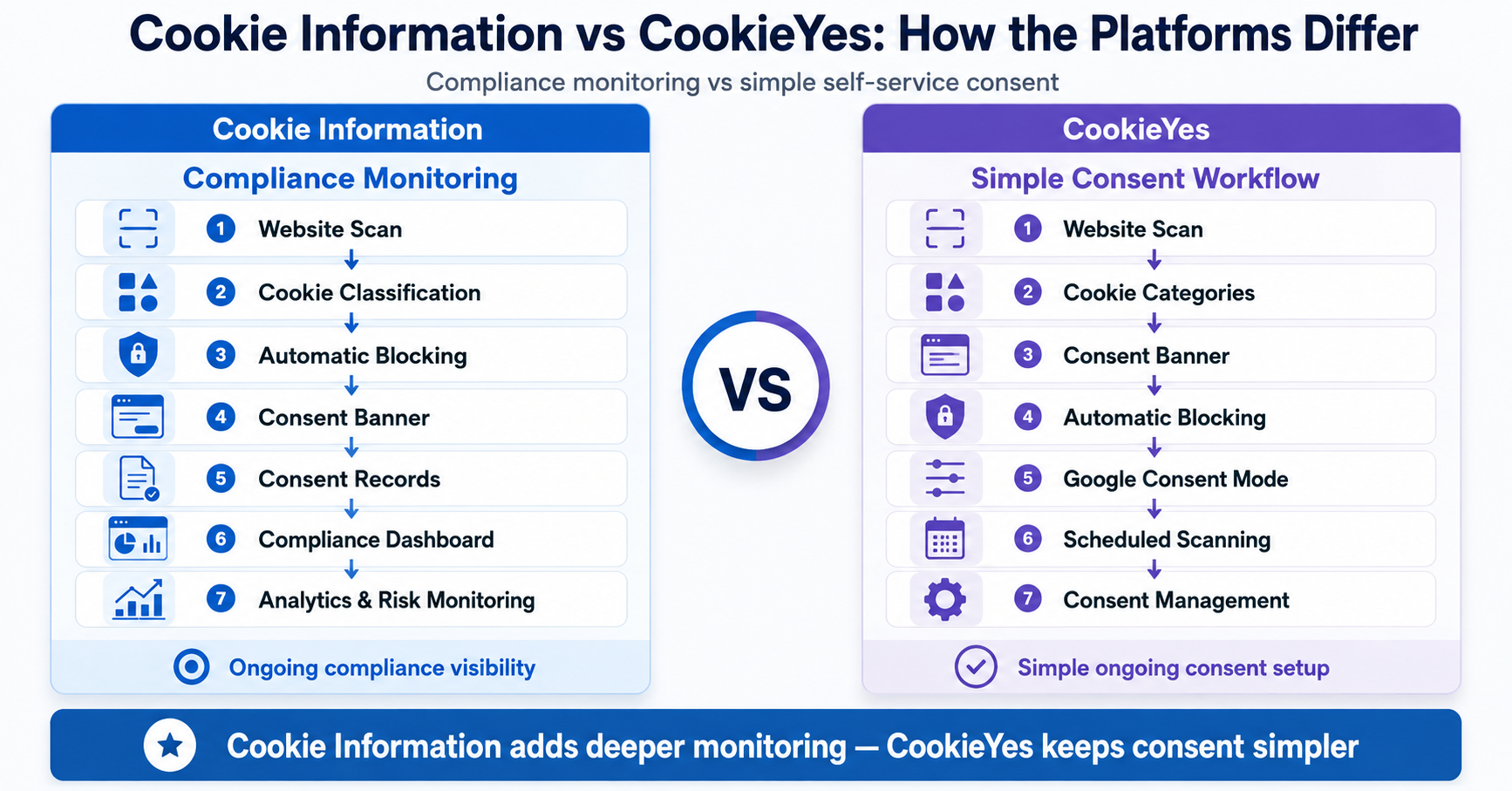
Cookie Information puts more emphasis on ongoing monitoring and compliance visibility.
Its workflow can include:
- website scanning
- cookie and tracker classification
- automatic blocking
- consent banners
- audit-ready consent records
- compliance dashboards
- consent-rate analytics
- compliance risk monitoring
CookieYes keeps the process more focused on simple day-to-day consent management.
Its typical workflow includes:
- website scanning
- cookie categorization
- consent-banner setup
- automatic blocking
- Google Consent Mode
- scheduled scanning on higher plans
- ongoing consent management
In simple terms, Cookie Information goes deeper into monitoring and analytics, while CookieYes makes the core consent workflow easier for smaller websites to manage.
Cookie Information Pricing
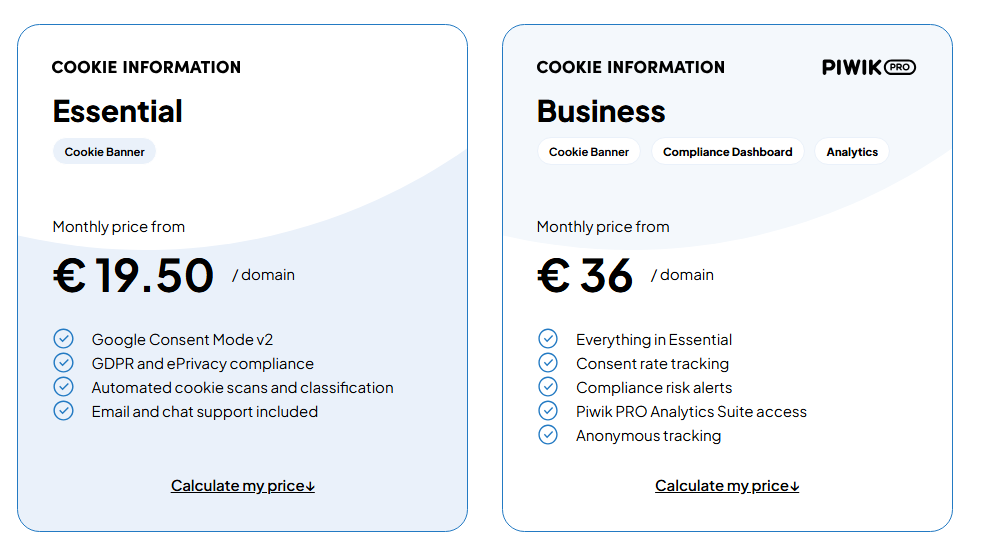
Cookie Information uses a configurable pricing model based on website size, scan frequency, and the level of monitoring required.
Essential
Essential pricing depends mainly on the number of URLs being scanned and how often the domain is scanned.
| Scanned URLs | Weekly Scan Price |
|---|---|
| Up to 500 URLs | €19.50/month/domain |
| Up to 5,000 URLs | €40/month/domain |
| Up to 15,000 URLs | €61/month/domain |
Essential includes core consent-management functionality together with automated cookie scanning and classification, Google Consent Mode v2, and an allowance of 25,000 monthly consents across the account.
Business
Cookie Information Business starts from:
€36/month/domain
Business adds more advanced monitoring and analytics functionality, including features such as:
- Compliance Dashboard
- consent-rate tracking
- compliance risk alerts
- analytics and reporting
- anonymous tracking functionality
The actual Business price can depend on the number of domains and tracked actions, so larger implementations may require a more customized calculation.
Want a closer look at Cookie Information Essential, Business, and the pricing model?
CookieYes Pricing
CookieYes uses a more familiar self-service pricing structure with four clearly defined tiers.
| Plan | Monthly Price | Pages per Scan | Monthly Pageviews |
|---|---|---|---|
| Free | $0 | 100 | 5,000 |
| Basic | $10/domain | 600 | 100,000 |
| Pro | $25/domain | 4,000 | 300,000 |
| Ultimate | $55/domain | 8,000 | Unlimited |
CookieYes Free is aimed at blogs and personal websites and includes up to 100 pages per scan and 5,000 monthly pageviews.
Basic increases the scan allowance to 600 pages and includes up to 100,000 monthly pageviews.
Pro supports 4,000 pages per scan, up to 300,000 monthly pageviews, geo-targeting, and monthly scheduled scanning.
Ultimate supports 8,000 pages per scan, unlimited pageviews, geo-targeting, weekly scheduled scanning, and additional advanced controls.
Basic and Pro can also incur additional pageview charges when the included monthly allowance is exceeded.
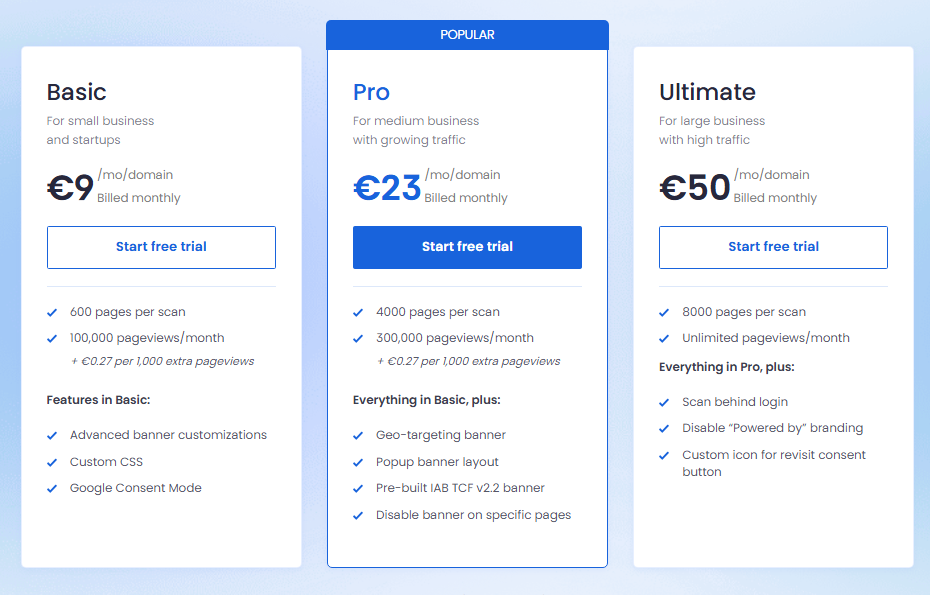
Want to compare CookieYes Free, Basic, Pro, and Ultimate?
Which Is Cheaper: Cookie Information or CookieYes?
CookieYes is usually the easier choice for small websites because it offers both a permanent Free plan and a lower paid entry point.
Example 1: Small Website or Blog
A small website can start with CookieYes Free:
$0/month
If more capacity is needed, CookieYes Basic starts at:
$10/month/domain
Cookie Information Essential starts at:
€19.50/month/domain
Winner for small-site pricing: CookieYes.
Example 2: Content Website With Hundreds of Pages
CookieYes Basic supports up to 600 pages per scan, while Pro supports up to 4,000 pages.
This provides a straightforward upgrade path for websites that need broader scan coverage.
Cookie Information can also support much larger URL counts, but its pricing depends more heavily on scan requirements and configuration.
For a typical self-service content website, CookieYes is usually easier to predict.
Example 3: Business Needing Compliance Monitoring
The comparison changes when the business needs more than scanning and consent banners.
If the organization also wants:
- consent-rate analytics
- compliance risk alerts
- Compliance Dashboard access
- deeper ongoing reporting
- audit-oriented monitoring
Cookie Information Business is designed more directly around these requirements.
Winner for advanced compliance monitoring: Cookie Information.
Small or medium website mainly needing consent: CookieYes is usually the better value.
Business needing deeper monitoring and analytics: Cookie Information can justify the higher starting price.
Cookie Information vs CookieYes Free Plan
This category has a clear winner.
Cookie Information
Cookie Information provides a 14-day free trial that can be used to test the platform before moving to a paid plan.
However, it does not provide the same type of permanent Free consent-management tier as CookieYes.
CookieYes Free
CookieYes Free includes:
- one domain
- 100 pages per scan
- 5,000 monthly pageviews
- basic customization
- core cookie-consent functionality
This gives small websites a useful long-term starting point without requiring a paid subscription.
Winner for free access: CookieYes.
Cookie Scanning
Both platforms provide automated scanning, but their strongest use cases are different.
Cookie Information scans websites and automatically categorizes detected cookies as part of its consent and compliance workflow.
Its scanning becomes particularly useful when the results are combined with ongoing monitoring and risk visibility.
CookieYes places strong emphasis on scan capacity.
Its plans support:
- 100 pages per scan on Free
- 600 pages per scan on Basic
- 4,000 pages per scan on Pro
- 8,000 pages per scan on Ultimate
Higher CookieYes plans also add scheduled scanning.
Winner for straightforward scan capacity: CookieYes.
Cookie Information has the advantage when scan results need to feed into deeper compliance monitoring.
Automatic Cookie Blocking
Both Cookie Information and CookieYes support automatic blocking as part of the consent workflow.
This helps prevent non-essential technologies from operating before the required consent is available.
Cookie Information connects blocking with its scanning, classification, and broader compliance system.
CookieYes also integrates blocking directly into its consent workflow and makes the setup accessible to small website owners.
For most websites, this category is a tie.
Consent Records
Both platforms can maintain evidence of consent, but Cookie Information places stronger emphasis on audit-ready consent records and ongoing compliance visibility.
This can matter for organizations that want a clearer record of how consent was collected and managed over time.
CookieYes also provides consent logging functionality, making it suitable for normal consent-management requirements.
Slight winner for audit-oriented consent records: Cookie Information.
Reporting and Compliance Monitoring
This is the clearest Cookie Information advantage.
Cookie Information Business includes tools designed to help organizations monitor consent and website tracking over time.
These can include:
- consent-rate tracking
- Compliance Dashboard visibility
- compliance risk alerts
- analytics and reporting
- visibility into changes in website tracking
This makes the platform attractive to businesses that view consent management as an ongoing compliance process rather than simply installing a banner and leaving it in place.
CookieYes provides reporting and consent-management functionality, but deeper compliance monitoring is not as central to its product positioning.
Winner for reporting and compliance monitoring: Cookie Information.
Cookie Banner Customization
Both platforms provide customizable consent banners.
Cookie Information supports pre-built templates, multiple languages, branding controls, and more advanced design options.
CookieYes also provides layouts, colors, text controls, language settings, and additional customization options across its paid plans.
For users who mainly want to configure a banner quickly, CookieYes can feel slightly more straightforward.
Slight winner for simple banner setup: CookieYes.
Google Consent Mode and Google Tag Manager
Both Cookie Information and CookieYes support Google Consent Mode v2.
This allows consent choices to affect how Google services behave and can form part of a setup involving:
- Google Analytics
- Google Ads
- Google Tag Manager
Both are therefore strong choices when Google integrations are an important part of the tracking setup.
This category is a tie.
Want to understand what Google Consent Mode actually does?
EU Hosting and European Privacy Focus
Cookie Information puts particularly strong emphasis on its European privacy positioning and EU-based infrastructure.
This can be attractive to European organizations that place a high priority on where consent-related data is processed and stored.
CookieYes supports GDPR and other major privacy frameworks and is suitable for European websites as well.
However, EU infrastructure is a more prominent part of Cookie Information’s positioning.
Slight winner for explicit EU-infrastructure focus: Cookie Information.
Cookie Information vs CookieYes for WordPress
Both platforms can be used with WordPress.
Cookie Information on WordPress
Cookie Information provides a WordPress integration that connects the website with its broader CMP and compliance-monitoring environment.
This can be useful when WordPress is only one part of a more advanced consent and reporting setup.
CookieYes on WordPress
CookieYes provides a very straightforward WordPress workflow.
A typical setup involves installing the plugin, scanning the website, configuring the banner, enabling blocking, and connecting Google consent settings when needed.
This makes CookieYes particularly accessible for bloggers, small businesses, and users who want to manage consent without a more complex compliance dashboard.
Winner for straightforward WordPress setup: CookieYes.
Cookie Information becomes more attractive when WordPress consent needs to connect with deeper monitoring and analytics.
Want to see how CookieYes works on WordPress?
Which Is Better for Different Types of Websites?
| Website Type | Better Fit | Why |
|---|---|---|
| Personal website or blog | CookieYes | Permanent Free plan and simple setup |
| Small business | CookieYes | Lower entry price and clear self-service plans |
| WordPress beginner | CookieYes | Accessible plugin workflow |
| Content-heavy website | CookieYes | Generous page-scan allowances |
| Business needing consent analytics | Cookie Information | Stronger consent-rate monitoring |
| Ongoing compliance monitoring | Cookie Information | Compliance dashboard and risk visibility |
| Audit-oriented consent management | Cookie Information | Stronger emphasis on audit-ready records |
| EU-infrastructure priority | Cookie Information | Strong European infrastructure positioning |
| Google Consent Mode | Tie | Both support Consent Mode v2 |
| Automatic blocking | Tie | Both support automatic blocking |
Cookie Information Pros and Cons
Pros
- strong ongoing compliance monitoring
- consent-rate analytics
- Compliance Dashboard
- compliance risk alerts
- audit-oriented consent records
- automated cookie scanning and classification
- automatic blocking
- Google Consent Mode v2 support
- strong EU infrastructure focus
Cons
- no permanent Free plan
- higher starting price than CookieYes
- pricing can become more complex as website and monitoring requirements grow
- advanced monitoring may be unnecessary for a simple website
CookieYes Pros and Cons
Pros
- strong permanent Free plan
- low paid entry price
- beginner-friendly setup
- generous page-scan limits
- scheduled scanning on higher plans
- automatic cookie blocking
- strong WordPress integration
- Google Consent Mode v2 support
- clear self-service pricing structure
Cons
- Free, Basic, and Pro have monthly pageview limits
- Basic and Pro can incur additional pageview charges
- less focused on advanced compliance monitoring
- businesses needing deeper analytics may prefer a more monitoring-oriented CMP
Cookie Information vs CookieYes: Which Is Better?
Cookie Information and CookieYes are both capable consent management platforms, but they are strongest in different situations.
For most small and medium websites, CookieYes is our overall recommendation.
Its permanent Free plan, lower paid entry price, generous scan limits, straightforward WordPress workflow, and simple self-service experience make it particularly attractive for bloggers, small businesses, and website owners who mainly need reliable cookie consent management.
Cookie Information is the stronger choice for organizations that want deeper monitoring after the banner is already running.
Its consent analytics, compliance dashboard, risk alerts, audit-oriented records, and stronger monitoring focus make it particularly useful for businesses that treat consent management as an ongoing compliance process.
| Category | Our Pick |
|---|---|
| Best permanent Free plan | CookieYes |
| Best for small websites | CookieYes |
| Best for beginners | CookieYes |
| Best straightforward WordPress setup | CookieYes |
| Best scan capacity | CookieYes |
| Best simple banner setup | CookieYes |
| Best consent analytics | Cookie Information |
| Best compliance monitoring | Cookie Information |
| Best audit-oriented consent records | Cookie Information |
| Best explicit EU-infrastructure focus | Cookie Information |
| Automatic blocking | Tie |
| Google Consent Mode | Tie |
Cookie Information vs CookieYes Scorecard
| Category | Cookie Information | CookieYes |
|---|---|---|
| Ease of use | 4.5 / 5 | 5.0 / 5 |
| Free option | 3.0 / 5 | 5.0 / 5 |
| Small-site pricing | 3.5 / 5 | 5.0 / 5 |
| Large-site scan value | 4.0 / 5 | 5.0 / 5 |
| Cookie scanning | 4.5 / 5 | 5.0 / 5 |
| Automatic blocking | 5.0 / 5 | 5.0 / 5 |
| Consent records | 5.0 / 5 | 4.5 / 5 |
| Reporting | 5.0 / 5 | 4.0 / 5 |
| Compliance monitoring | 5.0 / 5 | 3.5 / 5 |
| Google integration | 5.0 / 5 | 5.0 / 5 |
| WordPress | 4.5 / 5 | 5.0 / 5 |
| EU infrastructure focus | 5.0 / 5 | 4.0 / 5 |
| Simple self-service setup | 4.0 / 5 | 5.0 / 5 |
The scores are intended as a practical comparison for website owners rather than a universal ranking for every organization.
Conclusion
Cookie Information and CookieYes cover many of the same core consent-management requirements, but their strongest use cases are different.
CookieYes is our preferred option for most small and medium websites because it combines a strong permanent Free plan, straightforward paid tiers, generous scan limits, WordPress usability, and a simple self-service consent workflow.
Cookie Information is the stronger option for businesses that need consent management combined with deeper analytics, compliance monitoring, audit-oriented records, and stronger visibility into how their consent setup performs over time.
Take a Closer Look at CookieYes
CookieYes is a strong choice if you want a simple cookie consent solution with a permanent Free plan, solid scan limits, and an easy setup for small and medium websites. Read our full review for a closer look at its pricing, features, strengths, and limitations.

Frequently Asked Questions
Common questions about this topic
Cookie Information can be better for businesses that want deeper compliance monitoring, consent analytics, audit-oriented records, and more visibility into ongoing tracking and consent risks.
CookieYes can be better for small and medium websites that want a simpler setup, a permanent Free plan, lower entry pricing, generous scan limits, and strong WordPress usability.
CookieYes is usually cheaper for small websites because it has a permanent Free plan and Basic starts at $10 per domain per month. Cookie Information can make more sense when deeper monitoring and analytics are required.
Cookie Information offers a 14-day free trial, but it does not provide the same type of permanent Free plan as CookieYes.
Yes. CookieYes Free includes up to 100 pages per scan and 5,000 monthly pageviews.
CookieYes has particularly strong page-scan allowances, while Cookie Information becomes more attractive when scanning needs to feed into broader compliance monitoring and reporting.
Cookie Information is the stronger choice for ongoing compliance monitoring, consent analytics, and risk visibility.
CookieYes is generally the easier choice for WordPress users who mainly need straightforward cookie consent. Cookie Information is more attractive when the WordPress site is part of a broader monitoring and analytics workflow.
Yes. Both platforms support Google Consent Mode v2 and can work with services such as Google Analytics, Google Ads, and Google Tag Manager.