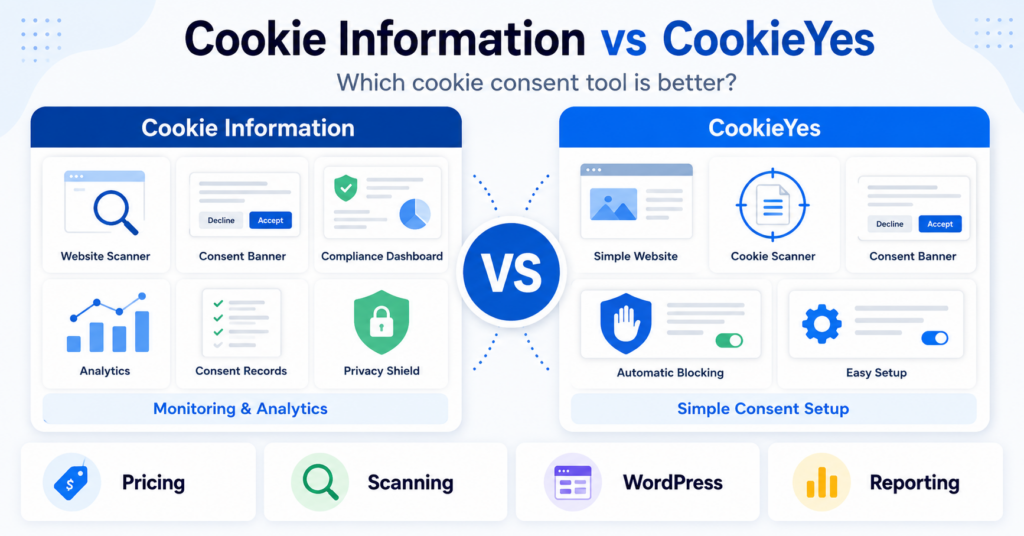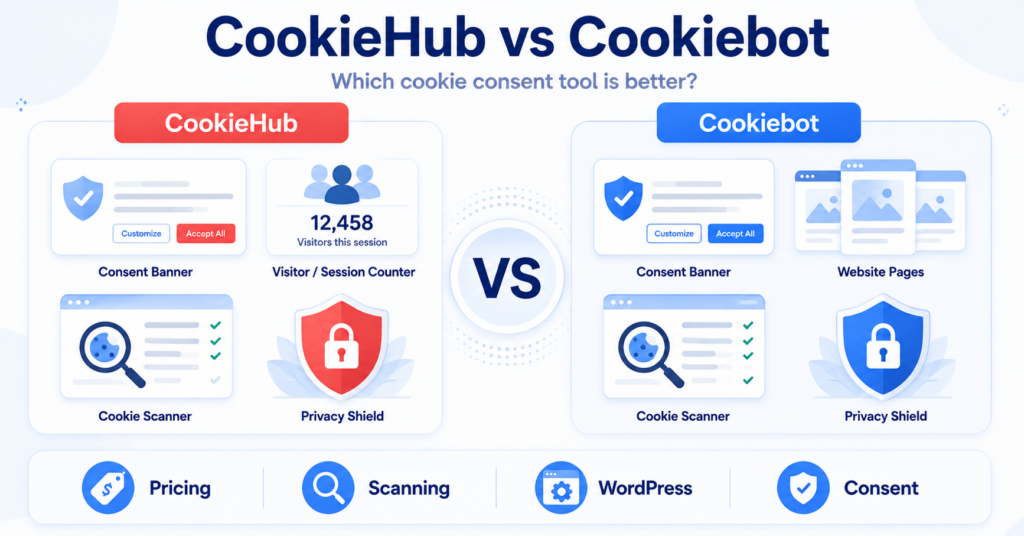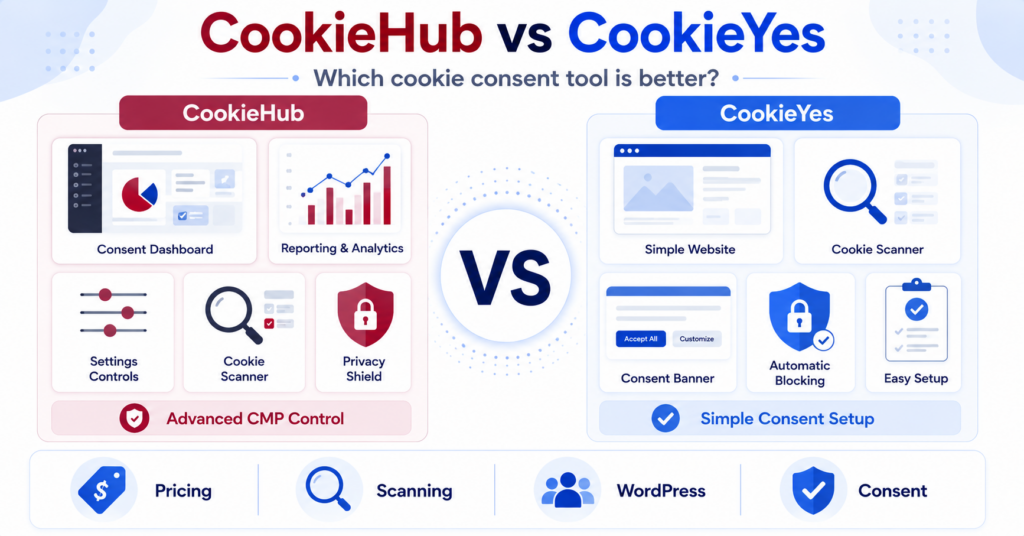
CookieHub and CookieYes are both modern consent management platforms with cookie scanning, automatic blocking, Google Consent Mode, and WordPress support, but they suit slightly different users.
CookieYes provides a particularly approachable setup for small businesses and WordPress users, while CookieHub offers a more advanced CMP environment with session-based pricing, consent reporting, technical integrations, and broader configuration options.
In this comparison, we look at pricing, free plans, scanning, WordPress, Google integrations, advanced CMP features, and which platform makes more sense for different websites.
Reviewed by: Cookie compliance specialist
5+ years of hands-on experience with GDPR and consent tools
Tested on real websites (WordPress, Shopify, and custom setups)
CookieHub vs CookieYes: Which Should You Choose?
Choose CookieYes if:
- you want a simple and beginner-friendly setup
- you run a small business or WordPress website
- you want a generous page-scan allowance
- you prefer pricing based on monthly pageviews
- you want an easy starting point without many advanced CMP settings
Choose CookieHub if:
- you want a more advanced consent-management environment
- you prefer session-based rather than pageview-based pricing
- consent records and compliance reporting are important
- you need more technical integrations and configuration options
- you expect your consent setup to become more complex over time
CookieYes is our pick for most beginners and small websites.
CookieHub is the stronger choice when you need more advanced consent management, reporting, integrations, or session-based pricing.
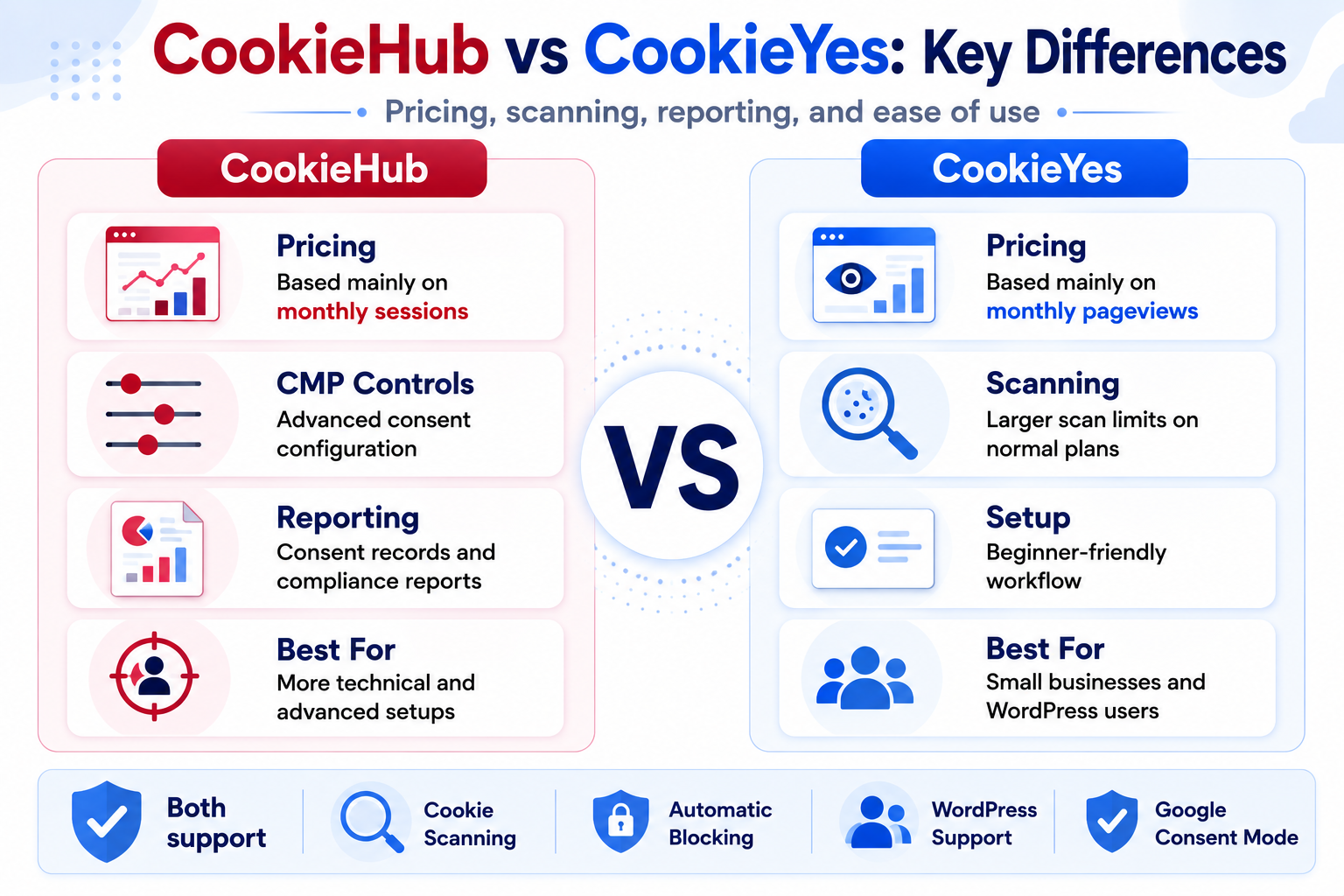
We compared current pricing, free-plan limits, cookie scanning, automatic blocking, banner controls, Google integrations, WordPress support, reporting, and advanced CMP functionality.
We also considered how each pricing model changes as website traffic and page count increase.
CookieHub vs CookieYes at a Glance
| Feature | CookieHub | CookieYes |
|---|---|---|
| Free plan | Yes | Yes |
| Main pricing model | Monthly sessions + scan limits | Monthly pageviews + scan limits |
| Free usage limit | Under 1,000 sessions/month | 5,000 pageviews/month |
| Free scan limit | Up to 50 pages | 100 pages per scan |
| Cookie scanning | Yes | Yes |
| Automatic blocking | Yes | Yes |
| Google Consent Mode | Yes | Yes |
| Consent reporting | Strong advanced reporting | Consent logs and trends |
| WordPress integration | Yes | Yes |
| Best fit | Advanced CMP and technical setups | Beginners and small websites |
Pricing checked: August 2026. CookieHub measures usage mainly in sessions, while CookieYes uses pageviews. These metrics are not directly interchangeable.
The Biggest Difference: Simplicity vs Advanced CMP Control
The biggest difference between CookieHub and CookieYes is not whether they can display a cookie banner.
Both platforms can scan websites, block non-essential scripts, collect consent, and integrate with Google services.
The difference is how much control and complexity each platform is designed to handle.
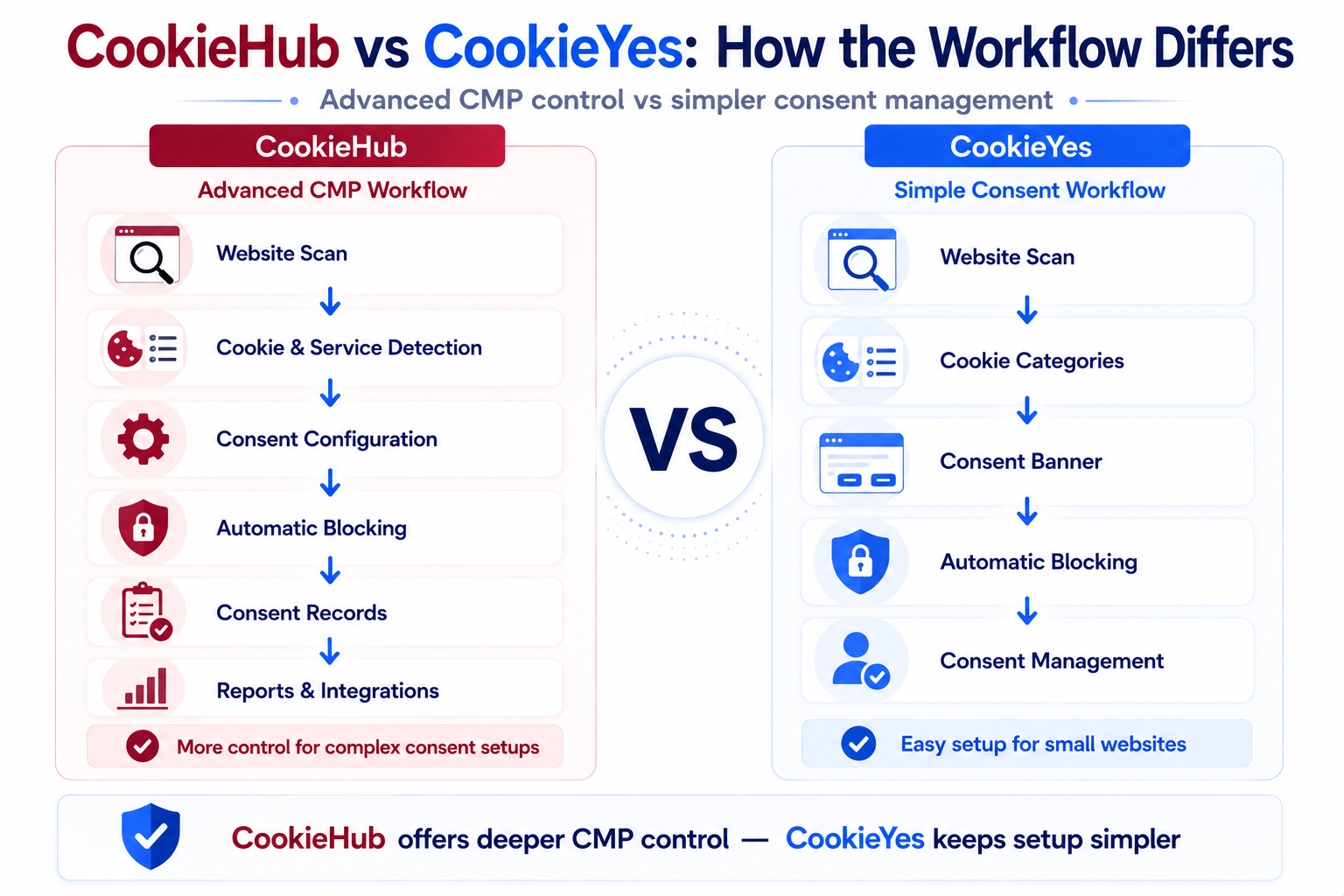
CookieYes focuses on making the core consent workflow straightforward.
The typical setup is:
- scan the website
- review detected cookies
- configure the consent banner
- enable automatic blocking
- connect Google Consent Mode if needed
CookieHub can go further into advanced CMP management.
Its broader workflow can include:
- cookie and service scanning
- consent configuration
- automatic blocking
- consent records
- compliance reporting
- geo-targeted consent rules
- technical integrations
- multi-domain consent management
For a typical small website, CookieYes can feel easier. For a growing or more technical consent environment, CookieHub provides more room to expand.
CookieHub Pricing
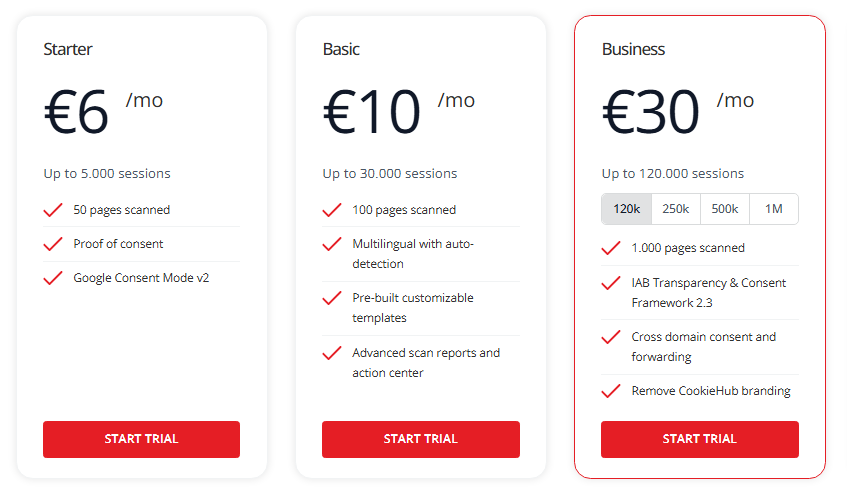
CookieHub uses session-based pricing together with page-scan limits.
A session represents a visitor’s browsing period rather than every individual page they load, so one visitor can generate several pageviews during a single session.
| Plan | Included Sessions | Approx. Pageviews | Page Scan Limit |
|---|---|---|---|
| Free | 1,000 | Approx. 25,000 | 50 |
| Starter | 5,000 | Approx. 125,000 | 100 |
| Basic | 30,000 | Approx. 500,000 | 100 |
| Business | 120,000–1,000,000 | Up to approx. 5 million | 1,000–10,000 |
| Enterprise | From 1,000,000 | 5 million+ | From 10,000 |
Paid compliance currently starts at €6 per month.
CookieHub’s session-based model can be attractive for websites where visitors typically view several pages during each visit.
However, the scan limit is equally important. Starter and Basic both have a 100-page scan limit, which can become restrictive for content-heavy websites even when the traffic allowance is sufficient.
Want a complete breakdown of CookieHub Free, Starter, Basic, Business, and Enterprise?
CookieYes Pricing
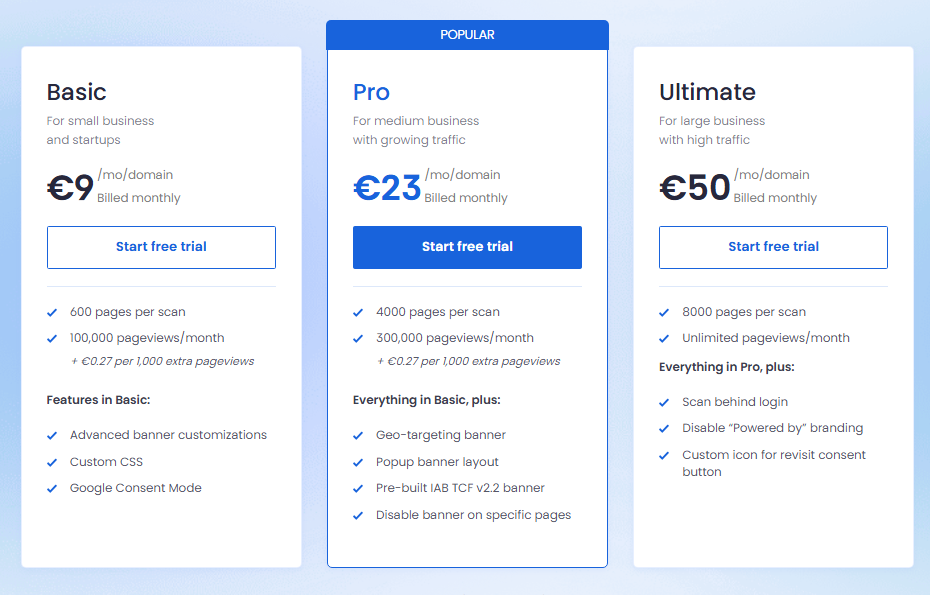
CookieYes combines monthly pageview allowances with page-scan limits.
| Plan | Monthly Price | Pages per Scan | Monthly Pageviews |
|---|---|---|---|
| Free | $0 | 100 | 5,000 |
| Basic | $10/domain | 600 | 100,000 |
| Pro | $25/domain | 4,000 | 300,000 |
| Ultimate | $55/domain | 8,000 | Unlimited |
CookieYes Basic and Pro can also continue beyond their included pageview allowances with additional usage charges.
CookieYes has a major advantage in scan capacity on its normal paid tiers. Basic supports up to 600 pages per scan, while Pro increases that to 4,000 pages and Ultimate to 8,000.
Pro also includes monthly scheduled scanning, while Ultimate provides weekly scheduled scans.
Want to compare CookieYes Free, Basic, Pro, and Ultimate?
Which Is Cheaper: CookieHub or CookieYes?
The pricing models are difficult to compare directly because CookieHub counts sessions while CookieYes counts pageviews.
The better value depends on both traffic behavior and website size.
Example 1: Small Low-Traffic Website
CookieYes Free supports up to:
100 pages per scan + 5,000 monthly pageviews
CookieHub Free supports:
1,000 monthly sessions + up to 50 pages scanned
For a small website where scan capacity matters, CookieYes Free has the advantage.
CookieHub can still provide strong traffic capacity because sessions and pageviews are measured differently.
Example 2: Small Website With Growing Traffic
CookieYes Basic provides:
600 pages per scan + 100,000 monthly pageviews
CookieHub Starter provides:
5,000 monthly sessions + approximately 125,000 pageviews + a 100-page scan limit
CookieHub can provide strong traffic value here, especially if visitors view multiple pages per session.
CookieYes, however, provides a much larger scan allowance.
Example 3: Content-Heavy Website
Imagine a website with several hundred or several thousand indexable pages.
CookieYes Basic can scan up to 600 pages, while Pro increases the limit to 4,000.
CookieHub Starter and Basic both have a 100-page scan limit.
That means a content-heavy website may need CookieHub Business even if its traffic would otherwise fit comfortably into a lower plan.
For larger content sites, CookieYes can therefore provide much better scan capacity for the price.
Need generous scan capacity: CookieYes is usually easier to fit into a lower tier.
Visitors view several pages per session: CookieHub’s session-based pricing can provide strong traffic value.
CookieHub vs CookieYes Free Plan
Both platforms offer useful Free plans.
CookieHub Free
CookieHub Free includes:
- fewer than 1,000 monthly sessions
- up to 50 pages scanned
- Proof of Consent
- Google Consent Mode v2
- automatic consent and blocking functionality
CookieYes Free
CookieYes Free includes:
- one domain
- 100 pages per scan
- 5 scans per month
- 5,000 monthly pageviews
- automatic cookie blocking
- Google Consent Mode v2
- consent logs
Which Free Plan Is Better?
For most small websites, CookieYes has a slight advantage.
The main reason is its larger 100-page scan limit together with automatic blocking and a straightforward setup.
CookieHub Free remains a strong option for very small websites where session-based traffic usage fits the pricing model well.
Cookie Scanning
Both platforms provide cookie and tracker scanning, but they have different strengths.
CookieYes offers very strong page allowances across its plans:
- 100 pages on Free
- 600 pages on Basic
- 4,000 pages on Pro
- 8,000 pages on Ultimate
Higher CookieYes plans also include scheduled scanning.
CookieHub combines scanning with a broader CMP environment, including detected services, consent records, reports, and more advanced configuration options.
Winner for scan capacity on typical small and medium plans: CookieYes.
CookieHub has the advantage when scanning is part of a broader advanced CMP and reporting workflow.
Automatic Cookie Blocking
Both CookieHub and CookieYes support automatic blocking of non-essential cookies and scripts before the required consent is provided.
CookieHub can automatically prevent commonly used tracking services from loading until the visitor gives consent.
CookieYes also includes cookie auto-blocking across its current plans.
This category is a tie.
Cookie Banner Customization
Both platforms allow website owners to customize the appearance and behavior of the consent banner.
CookieHub provides customizable consent experiences together with geo-targeted rules and broader CMP configuration.
CookieYes provides pre-built layouts, live previews, custom content, and additional design controls as you move through the plans.
For a beginner, CookieYes can feel slightly simpler.
For more advanced regional and consent configurations, CookieHub provides strong flexibility.
For most small websites, this category is effectively a tie.
Consent Reporting and Advanced CMP Features
This is one of CookieHub’s strongest areas.
CookieHub can provide consent records, compliance reports, consent preference information, geo-targeted consent rules, and more advanced technical configuration.
Its platform is designed not only to collect consent but also to help organizations document and manage that consent over time.
CookieYes is not basic in this area. It provides consent logs and consent-trend reporting, while higher plans add features such as geo-targeting, IAB TCF support, subdomain consent sharing, and other advanced controls.
However, CookieHub has the stronger overall position when reporting and advanced CMP management are major priorities.
Winner for advanced CMP controls and consent reporting: CookieHub.
Google Consent Mode and Google Tag Manager
Both CookieHub and CookieYes support Google Consent Mode v2.
CookieHub can integrate with Consent Mode and Google Tag Manager, while its WordPress plugin can also manage third-party tags according to the visitor’s consent choice.
CookieYes also supports Google Consent Mode v2 and Google Tag Manager across its current plans.
Both platforms can work with:
- Google Analytics
- Google Ads
- Google Tag Manager
This category is a tie.
Want to understand what Google Consent Mode actually does?
CookieHub vs CookieYes for WordPress
Both platforms provide WordPress integrations.
CookieHub on WordPress
CookieHub provides a dedicated WordPress plugin with automatic cookie blocking, Consent Mode support, and controls for third-party tags.
It is a good fit for website owners who want WordPress integration while still using a broader cloud CMP.
CookieYes on WordPress
CookieYes also provides a dedicated WordPress plugin.
The workflow is particularly accessible for users who want to install the plugin, scan the site, configure the banner, enable blocking, and manage consent without dealing with a large number of advanced settings.
Winner for WordPress beginners: CookieYes.
CookieHub becomes more attractive when the WordPress site is part of a broader multi-platform or more technically advanced CMP setup.
Want to see how each platform works in practice?
Which Is Better for Different Types of Websites?
| Website Type | Better Fit | Why |
|---|---|---|
| Beginner website owner | CookieYes | Straightforward consent setup |
| Small business website | CookieYes | Strong Free and Basic plans |
| WordPress beginner | CookieYes | Accessible plugin workflow |
| Content-heavy website | CookieYes | Larger scan limits on standard plans |
| Advanced consent-management setup | CookieHub | Broader CMP configuration and reporting |
| Consent reporting priority | CookieHub | Strong compliance evidence and reports |
| Technical integrations | CookieHub | Broader developer and multi-platform workflow |
| Session-based pricing preference | CookieHub | Usage is measured primarily by sessions |
| Automatic blocking | Tie | Both provide automatic blocking |
| Google Consent Mode | Tie | Both support Consent Mode v2 |
CookieHub Pros and Cons
Pros
- advanced CMP controls
- session-based pricing
- consent logs and compliance reporting
- automatic cookie blocking
- Google Consent Mode v2 support
- geo-targeted consent settings
- strong technical and multi-platform integrations
- good option for more complex consent environments
Cons
- Free plan has a smaller scan limit than CookieYes
- Starter and Basic are limited to 100 scanned pages
- advanced functionality can be more than a simple site needs
- session-based pricing is less immediately intuitive than pageview pricing for some users
CookieYes Pros and Cons
Pros
- beginner-friendly setup
- strong Free plan
- generous scan limits
- automatic cookie blocking
- strong WordPress integration
- Google Consent Mode v2 support
- scheduled scanning on higher plans
- straightforward banner customization
Cons
- Free, Basic, and Pro use monthly pageview limits
- additional pageviews can create extra costs on Basic and Pro
- unlimited pageviews require Ultimate
- less focused on advanced CMP reporting than CookieHub
CookieHub vs CookieYes: Which Is Better?
CookieHub and CookieYes are both strong consent management platforms, but they are optimized for different users.
For most beginners, small businesses, and straightforward WordPress websites, CookieYes is our overall recommendation.
Its strong Free plan, larger scan allowances, automatic blocking, easy WordPress workflow, and simple consent-management experience make it an accessible starting point.
CookieHub is the stronger choice when you need more advanced CMP controls, consent reporting, technical integrations, or session-based pricing.
It also becomes increasingly attractive for organizations managing more complex consent setups across several platforms or domains.
| Category | Our Pick |
|---|---|
| Best for beginners | CookieYes |
| Best free plan | CookieYes |
| Best for WordPress beginners | CookieYes |
| Best scan capacity | CookieYes |
| Best for content-heavy websites | CookieYes |
| Best advanced CMP controls | CookieHub |
| Best consent reporting | CookieHub |
| Best technical integrations | CookieHub |
| Best session-based traffic value | CookieHub |
| Automatic blocking | Tie |
| Google Consent Mode | Tie |
CookieHub vs CookieYes Scorecard
| Category | CookieHub | CookieYes |
|---|---|---|
| Ease of use | 4.0 / 5 | 4.5 / 5 |
| Free plan | 4.0 / 5 | 4.5 / 5 |
| WordPress beginners | 4.0 / 5 | 5.0 / 5 |
| Cookie scanning capacity | 4.0 / 5 | 5.0 / 5 |
| Automatic blocking | 4.5 / 5 | 4.5 / 5 |
| Google integration | 5.0 / 5 | 5.0 / 5 |
| Banner customization | 4.5 / 5 | 4.5 / 5 |
| Advanced CMP controls | 5.0 / 5 | 4.5 / 5 |
| Consent reporting | 5.0 / 5 | 4.0 / 5 |
| Technical integrations | 5.0 / 5 | 4.5 / 5 |
| Traffic pricing flexibility | 4.5 / 5 | 4.0 / 5 |
| Platform flexibility | 5.0 / 5 | 4.5 / 5 |
The scores are intended as a practical comparison for small and medium website owners rather than a universal ranking for every business.
Conclusion
CookieHub and CookieYes provide many of the same core consent-management features, but they serve slightly different priorities.
CookieYes is our preferred choice for most beginners and small websites because it combines strong scan limits, automatic blocking, WordPress usability, and a capable Free plan.
CookieHub is the stronger choice when consent reporting, advanced CMP configuration, technical integrations, or session-based pricing are more important than keeping the workflow as simple as possible.
Take a Closer Look at CookieYes
CookieYes is our preferred choice for most beginners and small websites, while CookieHub is stronger for more advanced CMP requirements. Read our CookieYes review for a closer look at its features, pricing, setup experience, strengths, and limitations.
Frequently Asked Questions
Common questions about this topic
CookieHub can be better for websites that need advanced CMP controls, consent reporting, technical integrations, or session-based pricing. CookieYes is generally easier for beginners and small websites.
CookieYes can be better for small websites, WordPress beginners, and content-heavy sites that need larger scan allowances without moving immediately to a high-tier plan.
It depends on traffic behavior and website size. CookieHub uses session-based pricing, while CookieYes uses pageview allowances and scan limits. CookieHub can provide strong traffic value, while CookieYes can offer better scan capacity on lower plans.
Yes. CookieHub Free is available for individual subscriptions with fewer than 1,000 monthly sessions and supports up to 50 scanned pages.
Yes. CookieYes Free includes up to 100 pages per scan, five scans per month, 5,000 monthly pageviews, and automatic cookie blocking.
CookieYes has a slight advantage for most small websites because it provides a larger scan allowance and a particularly straightforward consent workflow.
Both support WordPress. CookieYes is easier for many beginners, while CookieHub can be more attractive when the WordPress site is part of a broader advanced or multi-platform CMP setup.
Yes. Both platforms support Google Consent Mode v2 and can work with Google Analytics, Google Ads, and Google Tag Manager.