Switzerland does not follow exactly the same cookie consent model as the European Union. Many websites may use a transparency and opt-out approach, while certain forms of tracking require prior consent.
The main rules come from the Swiss Federal Act on Data Protection, commonly called the FADP, and the Telecommunications Act. The correct approach depends on what the technology does, which information it collects, and how seriously it affects the visitor’s privacy.
This guide explains when consent may be required, when an opt-out may be sufficient, and what a Swiss cookie banner should include.
Switzerland does not require every website to use an EU-style opt-in cookie banner.
Visitors must generally receive clear information and an effective way to control non-essential tracking. Prior consent may be required for high-risk profiling, sensitive personal data, particularly intrusive tracking, and certain personalised advertising systems.
What Are Switzerland’s Cookie Consent Laws?
Switzerland does not have one law dedicated exclusively to browser cookies. Cookies and similar tracking technologies are mainly regulated through:
- the Federal Act on Data Protection: regulates the processing of personal data and is commonly called the FADP;
- the Data Protection Ordinance: provides additional rules supporting the FADP;
- the Telecommunications Act: includes requirements concerning information stored on or accessed from a user’s device;
- official FDPIC guidance: explains how Swiss data protection principles apply to cookies and similar technologies.
The Federal Data Protection and Information Commissioner is commonly known as the FDPIC.
If you want to compare Switzerland with other regions, begin with our guide to cookie consent laws around the world.
Is Switzerland Covered by the GDPR?
Switzerland is not a member of the European Union or the European Economic Area. Its main domestic data protection law is therefore the Swiss FADP rather than the EU GDPR.
However, the GDPR may still apply to a Swiss business when it:
- offers goods or services to people in the European Union;
- monitors the behaviour of people located in the EU;
- uses tracking to create profiles of EU visitors;
- operates through an establishment located in the EU.
A Swiss website serving European visitors may therefore need to comply with both Swiss and EU requirements.
For a closer look at the European model, see our guide to EU cookie consent laws.
Do not determine the applicable rules only from the location of the company or its server. Visitor location, service targeting, tracking activities, and the information collected may also matter.
FADP vs EU Cookie Consent Rules
The Swiss and European systems share principles such as transparency, data minimisation, security, and visitor control. However, their practical cookie consent models are not identical.
| Area | Switzerland | European Union |
|---|---|---|
| Main framework | FADP, Data Protection Ordinance, and Telecommunications Act | GDPR and national laws implementing the ePrivacy Directive |
| Common starting point | Clear information and an effective choice, which may use opt-in or opt-out depending on the processing | Prior consent for many non-essential storage and access technologies |
| Consent for non-essential cookies | Depends on the processing and privacy risk; prior consent is not automatically required in every case | Generally required before non-essential cookies covered by ePrivacy rules are activated |
| Higher-risk tracking | Consent may be required for high-risk profiling or a particularly serious privacy intrusion | Prior consent is commonly required for advertising and cross-site tracking |
| Banner model | May use an opt-out or opt-in model depending on the processing | Usually uses an opt-in model with Accept, Reject, and preference controls |
A website should not automatically copy an EU configuration for Switzerland without reviewing its tracking activities. However, an EU-style opt-in banner may still be an appropriate and practical choice, especially for an international website.
Which Technologies Are Covered?
Swiss requirements are not limited to files labelled as browser cookies. They may apply whenever a technology stores information, accesses information, or processes data connected to a person or device.
Covered technologies may include:
- browser cookies;
- tracking pixels and web beacons;
- local storage and session storage;
- advertising identifiers;
- scripts and tags;
- device fingerprinting;
- tracking parameters in links;
- embedded videos, maps, and social media services;
- mobile app identifiers and software development kits;
- location tracking technologies.
Whether a technology is first-party or third-party does not answer the compliance question by itself. Its purpose, data flows, providers, duration, and privacy risks must also be considered.
Learn more about these technologies in our guides to the different types of website cookies and browser fingerprinting.
When Is Cookie Consent Required in Switzerland?
Swiss law does not impose one universal prior-consent rule for every non-essential cookie. However, consent becomes more important when tracking creates a serious privacy risk.
Prior consent may be required when a website uses cookies or similar technologies to:
- process sensitive personal data;
- perform high-risk profiling;
- track visitors extensively across different websites or services;
- combine information from several sources into detailed visitor profiles;
- share personal information with advertising providers in particularly intrusive circumstances;
- collect detailed location information;
- make decisions that significantly affect a person;
- cause a particularly serious intrusion into a visitor’s privacy.
The FDPIC’s cookie guidance explains that certain personalised advertising arrangements may require consent. One example is allowing third parties to access visitor information through technologies embedded across several websites, enabling those providers to conduct high-risk profiling.
A simple cookie remembering a visitor’s selected language has a very different privacy impact from an advertising identifier used to follow the visitor across many unrelated websites.
When May an Opt-Out Be Enough?
An opt-out approach may be possible when processing is transparent, expected, proportionate, and does not seriously interfere with the visitor’s privacy.
Examples could include:
- remembering a basic website preference;
- limited first-party website measurement;
- personalising a website without creating a detailed cross-site profile;
- using low-risk technologies that collect minimal information;
- processing that visitors can easily understand and stop.
The website must still provide clear information. Visitors should also receive an accessible and effective way to object or disable the processing.
An opt-out should not be hidden in a long privacy policy or require unnecessary steps. The control should work correctly and stop the relevant technologies.
Do not assume that browser settings alone provide an adequate choice for complex advertising, profiling, or third-party tracking. Website-specific controls are generally clearer and easier for visitors to use.
Personalised Advertising and High-Risk Profiling
Personalised advertising can involve collecting information about pages viewed, searches, purchases, interests, locations, and interactions over time.
The privacy risk becomes greater when:
- the same provider tracks a visitor across many websites;
- information from different sources is combined;
- the tracking reveals sensitive interests or personal circumstances;
- detailed profiles are created about an identifiable person;
- location information is used to infer where a person lives or works;
- visitor information is provided to third parties in return for payment or another benefit.
According to the FDPIC’s updated guidance, certain systems of this kind may amount to high-risk profiling and a particularly serious intrusion into privacy. Prior consent may then be required.
A website using personalised advertising should identify every provider, understand where information is sent, and determine whether the provider follows visitors across other services.
Do Analytics Cookies Require Consent in Switzerland?
There is no single answer for every analytics tool. The correct approach depends on how the analytics system is configured and what happens to the information.
A limited analytics setup may present a lower risk when it:
- is used only to measure the website’s performance;
- collects the minimum information necessary;
- does not identify or profile individual visitors;
- does not combine analytics information with advertising data;
- does not follow visitors across unrelated websites;
- uses short retention periods;
- provides visitors with a simple opt-out.
Consent is more likely to be appropriate when analytics is used to:
- track individual visitors over time;
- build audience or interest profiles;
- connect website activity with advertising information;
- share data with multiple third-party providers;
- follow visitors across websites or devices;
- personalise content for specific people or groups.
Website owners should review the actual configuration rather than relying only on the name of the tool. Our separate guide explains what to consider when configuring Google Analytics cookie consent.
What Counts as Valid Cookie Consent in Switzerland?
When consent is required, it must give the visitor a genuine and informed choice.
Valid consent should generally be:
- freely given: the visitor should not face unfair pressure;
- informed: the visitor should understand what will happen;
- specific: consent should cover clearly described purposes;
- unambiguous: the visitor should make a clear choice;
- given before the relevant processing: technologies requiring consent should remain disabled until permission is received;
- withdrawable: changing the choice should be reasonably easy.
When sensitive personal data or high-risk profiling is involved, explicit consent may be required.
The following methods should not be treated as reliable consent:
- pre-ticked checkboxes;
- pre-enabled advertising categories;
- silence or inactivity;
- scrolling the page;
- continuing to browse;
- button designs that hide or misrepresent the available choices.
The website should keep appropriate records showing when consent was obtained, what information was presented, and which purposes the visitor accepted.
Does your website also serve visitors in the European Union?
Swiss Cookie Banner Requirements
A Swiss website does not automatically need an EU-style cookie banner. The appropriate design depends on whether the website uses an opt-out model, an opt-in model, or both.
A cookie banner or preference interface should generally:
- clearly explain that cookies or similar technologies are being used;
- identify their main purposes;
- distinguish necessary functions from analytics, personalisation, and advertising;
- explain whether third parties receive or access information;
- provide a suitable opt-in or opt-out control;
- avoid activating technologies that require consent before a choice is made;
- allow visitors to change or withdraw their choices later;
- link to more complete cookie and privacy information;
- work correctly on desktop, mobile, and tablet devices.
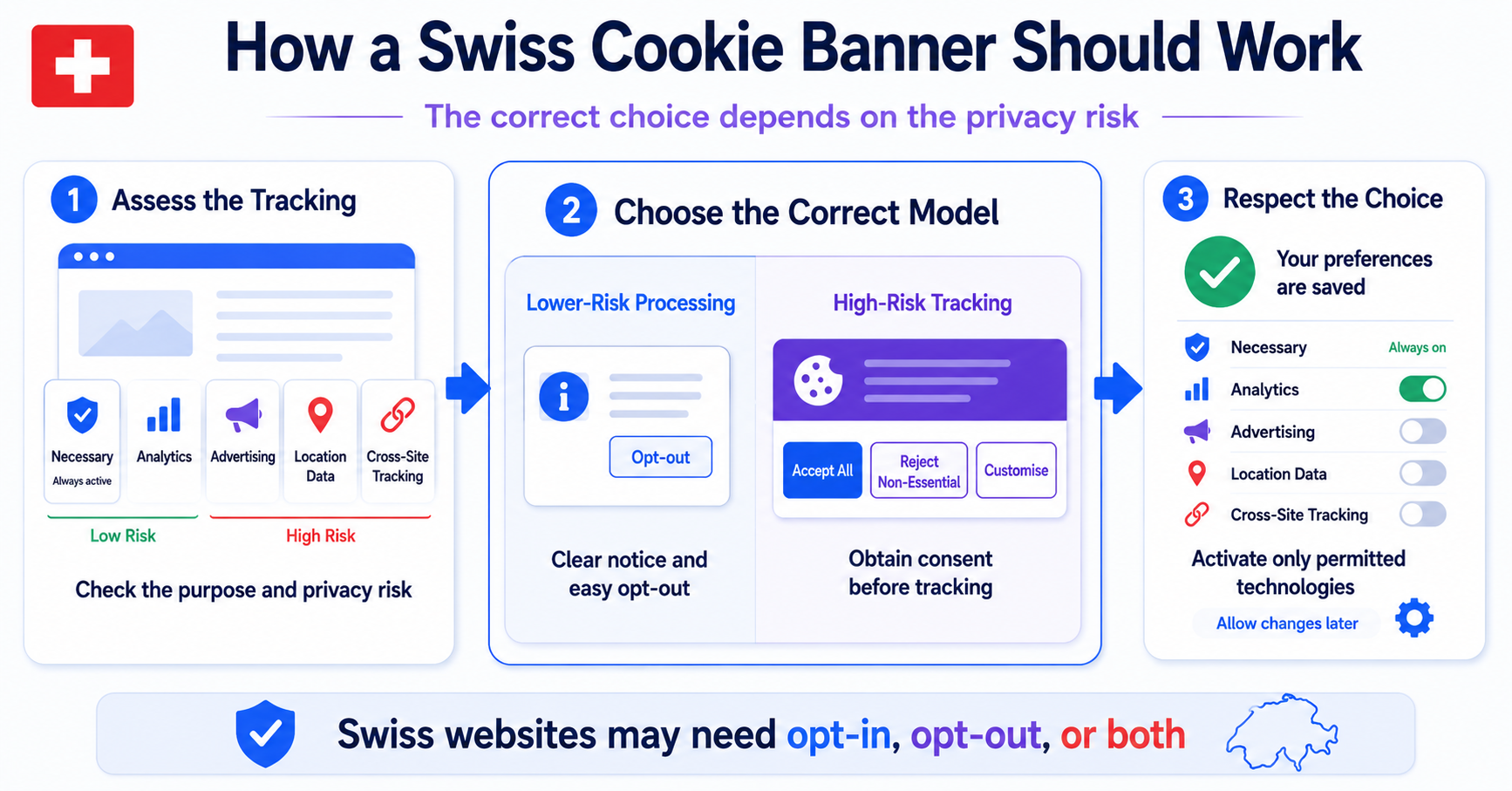
Opt-out banner model
An opt-out model may inform the visitor that certain low-risk technologies are active and provide a clear way to disable them.
The opt-out control should be easy to find and should stop the relevant processing. A vague statement such as “you can change your browser settings” may not provide enough practical control for complex tracking.
Opt-in banner model
An opt-in model should block the relevant technologies before the visitor makes a choice. The first layer could include:
- Accept All
- Reject Non-Essential
- Customise Choices
The second layer can provide separate controls for analytics, advertising, personalisation, embedded services, and other purposes.
See our complete guide to cookie banner requirements for more design and configuration guidance.
Does a Swiss Cookie Banner Need a Reject All Button?
Swiss law does not require every website to display one specific button label. A “Reject All” button is therefore not automatically mandatory for every Swiss website.
However, when a website asks visitors to consent to non-essential tracking, refusing should be as clear and practical as accepting.
If the first layer displays an “Accept All” button, the clearest approach is to provide a visible “Reject Non-Essential” or “Reject All” option on the same layer.
A banner should not:
- hide rejection inside a complicated settings menu;
- require significantly more steps to reject than to accept;
- use a much brighter or larger acceptance button;
- use misleading wording to encourage acceptance;
- activate consent-based technologies before the visitor agrees.
A consent banner displays “Accept All,” “Reject Non-Essential,” and “Customise” as three clearly visible controls. Advertising cookies remain disabled unless the visitor actively accepts them.
Are Cookie Paywalls Allowed in Switzerland?
A cookie paywall gives visitors a choice between accepting certain data processing and paying for access without that processing.
Cookie paywalls are not automatically valid or invalid in every situation. The FDPIC’s updated cookie guidance explains that the validity of consent depends on the circumstances.
Important factors may include:
- whether the visitor has a genuine alternative;
- whether the paid option is clearly explained;
- whether the price and conditions are reasonable;
- how intrusive the tracking is;
- whether the service is essential or difficult to obtain elsewhere;
- whether refusing causes an unfair disadvantage;
- whether the visitor can later withdraw consent.
A website should not assume that offering a paid subscription automatically makes consent freely given. Cookie paywalls require a separate assessment of the service, tracking activities, and available alternatives.
Does a Swiss Website Need a Cookie Policy?
Website owners must provide clear information when cookies or similar technologies process personal data.
A cookie policy should normally explain:
- which cookies and similar technologies are used;
- the purpose of each technology;
- which information is collected or accessed;
- which providers control or receive the information;
- whether a technology is first-party or third-party;
- how long it remains active;
- whether information is transferred to another country;
- whether consent is required or an opt-out is provided;
- how visitors can manage or withdraw their choices.
The most important information should be available directly from the banner or preference interface. More complete details can be provided on a separate policy page.
Learn how to organise this information in our guide on how to create a cookie policy page.
Do Swiss Cookie Laws Apply to Websites Outside Switzerland?
A business may need to consider Swiss requirements even when its company or server is located in another country.
Relevant factors can include:
- whether the website offers goods or services to people in Switzerland;
- whether it targets Swiss customers;
- whether people in Switzerland are monitored or profiled;
- whether personal data about Swiss visitors is processed;
- whether the processing has significant effects in Switzerland.
The geographical scope of each applicable law should be assessed separately. An international website may need to consider Swiss, EU, UK, or other regional requirements at the same time.
A website located in Switzerland may still need an EU-style opt-in banner when it targets or monitors visitors in the European Union.
Who Enforces Switzerland’s Cookie Rules?
The Federal Data Protection and Information Commissioner supervises compliance with the FADP and publishes guidance about cookies and similar technologies.
Depending on the issue, other authorities or courts may also become involved. Telecommunications, consumer protection, contract, and competition rules can sometimes be relevant alongside data protection law.
The website owner remains responsible for understanding its technologies and configuring its consent mechanism correctly. Installing a third-party cookie banner or consent management platform does not automatically make the website compliant.
What Happens If a Website Does Not Comply?
Possible consequences can include:
- questions or requests for information from the FDPIC;
- a data protection investigation;
- requirements to change or stop unlawful processing;
- recommendations or formal proceedings;
- civil claims from affected people;
- criminal penalties for certain intentional violations;
- loss of visitor trust;
- problems with advertising or analytics providers.
Compliance decisions should not be based only on the possible size of a penalty. Incorrect tracking can also produce unreliable analytics, invalid consent records, complaints, and damage to the website’s reputation.
Practical Swiss Cookie Compliance Checklist
Website owners can use the following steps to review their Swiss cookie and tracking setup.
Use these steps to identify the requirements that may apply to your website.
- Identify your technologies. Check cookies, pixels, scripts, tags, local storage, embeds, advertising identifiers, and fingerprinting.
- Record each purpose. Explain why every technology is used and what information it handles.
- Identify every provider. Determine which third parties receive or access visitor information.
- Assess the privacy risk. Look for cross-site tracking, detailed profiling, sensitive information, and location data.
- Choose the correct consent model. Decide whether the processing requires opt-in consent or can use a clear opt-out.
- Block consent-based technologies. Keep them disabled until the visitor makes a valid choice.
- Provide balanced controls. Make accepting, rejecting, and changing preferences straightforward.
- Publish clear information. Keep your cookie and privacy information complete and accurate.
- Allow withdrawal. Give visitors an accessible way to reopen their settings.
- Keep appropriate records. Record when and how consent choices were made.
- Test the final setup. Confirm that every category responds correctly to visitor choices.
- Repeat the review. Check again whenever plugins, tags, embeds, or providers change.
A cookie audit can help identify the technologies your website currently loads.
After configuring your consent solution, follow our guide on how to test a cookie banner.
Official Swiss Cookie Guidance
The FDPIC published detailed guidance explaining how the FADP and other Swiss requirements apply to cookies and similar technologies.
Website owners can consult the following official sources:
- FDPIC updated cookie guidance;
- FDPIC practical information about cookies and visitor control;
- Swiss Federal Act on Data Protection;
- Swiss Telecommunications Act.
Cookie technologies and official guidance can change. Website owners should review their setup regularly instead of treating compliance as a one-time task.
Conclusion
Switzerland’s cookie requirements are mainly based on the FADP, the Data Protection Ordinance, the Telecommunications Act, and the supervisory guidance of the FDPIC.
Unlike the European Union, Switzerland does not apply one universal prior-consent rule to every non-essential cookie. Some lower-risk processing may use clear information and an effective opt-out.
Prior consent becomes more important when tracking involves sensitive personal data, high-risk profiling, extensive cross-site tracking, detailed location information, or a particularly serious intrusion into privacy.
The practical starting point is to identify what the website loads, understand why each technology is used, assess its privacy risks, and then choose the correct opt-in or opt-out model.
The next step is to apply these rules to your own website and check which cookies and trackers it uses.
This article provides general information about cookie consent and privacy requirements. It does not constitute legal advice.

Frequently Asked Questions
Common questions about this topic
No. A Swiss website does not automatically need an EU-style cookie banner. The correct solution depends on which cookies and tracking technologies it uses. A banner or preference interface becomes important when visitors need to receive information, opt out of processing, or provide prior consent.
Not always. Limited, privacy-friendly analytics may sometimes use clear notice and an effective opt-out. Consent is more likely to be required when analytics identifies visitors, creates profiles, connects data with advertising, or tracks people across websites.
Switzerland is not part of the European Union or European Economic Area, so its main domestic privacy law is the FADP. However, the GDPR may still apply when a Swiss website offers services to people in the EU or monitors their behaviour.
Prior consent may be required when tracking involves sensitive personal data, high-risk profiling, extensive cross-site tracking, detailed location data, or another particularly serious intrusion into a visitor’s privacy.
Not every Swiss website is legally required to use a button with that exact label. However, if a banner asks visitors to accept non-essential tracking, refusing should be as clear and easy as accepting. Showing “Accept All” and “Reject Non-Essential” on the same layer is the clearest approach.
Yes, an opt-out model may be appropriate for certain transparent and lower-risk processing. Visitors must receive clear information and an effective way to stop the relevant technologies. High-risk or particularly intrusive tracking may require prior opt-in consent instead.
Cookie paywalls are not automatically allowed or prohibited in every case. Their validity depends on whether the visitor has a genuine choice, how intrusive the tracking is, the conditions of the paid alternative, and whether consent can be freely given and withdrawn.
A website should provide clear information when cookies or similar technologies process personal data. A cookie policy should explain which technologies are used, their purposes, providers, duration, data sharing, and how visitors can manage their choices.